For shivarAtri:arjuna with shiva kirATa,along with his hymn to him(from the Mahabharata,vana parva)

Screenshot_2019-03-03_19-21-42


From the Vana Parva,text of arjuna’s stotra along with Ganguli’s translation(Am using the Kumbhakonam recension)

kapardinsarvabhūteśa bhaganetranipātana ।
[devadeva mahādeva nīlagrīva jaṭādhara ॥ 3-39-74 (17332)
kāraṇānāṃ ca paramaṃ jāne tvāṃ tryambakaṃ vibhum ।
devānāṃ ca gatiṃ devaṃ tvatprasūtamidaṃ jagat ॥ 3-39-75 (17333)
ajeyastvaṃ tribhirlokaiḥ sadevāsuramānuṣaiḥ ।
śivāya viṣṇurūpāya viṣṇave śivarūpiṇe ॥ 3-39-76 (17334)
dakṣiyajñavināśāya harirūpāya te namaḥ ।
lalāṭākṣāya śarvāya mīḍhuṣe śūlapāṇaye ॥ 3-39-77 (17335)
pinākagoptre sūryāya maṅgalyāya ca vedhase ।
prasādaye tvāṃ bhagavansarvabhūtamaheśvara ॥ 3-39-78 (17336)
gaṇeśaṃ jagataḥ śambhuṃ lokakāraṇakāraṇam ।
pradhānapuruṣātītaṃ paraṃ sūkṣmataraṃ haram ॥ 3-39-79 (17337)
vyatikramaṃ me bhagavankṣantumarhasi śaṃkara ।
bhagavandarśanākāṅkṣī prāptosmīmaṃ mahāgirim ॥ 3-39-80 (17338)
dayitaṃ tava deveśa tāpasālayamuttamam ।
prasādaye tvāṃ bhagavansarvalokanamaskṛtam ॥ 3-39-81 (17339)
kṛto mayā’yamajñānādvimardo yastvayā saha ।
śaraṇaṃ pratipannāya tatkṣamasvādya śaṃkara ॥

कपर्दिन्सर्वभूतेश भगनेत्रनिपातन ।
[देवदेव महादेव नीलग्रीव जटाधर ॥ ३-३९-७४ (१७३३२)
कारणानां च परमं जाने त्वां त्र्यम्बकं विभुम् ।
देवानां च गतिं देवं त्वत्प्रसूतमिदं जगत् ॥ ३-३९-७५ (१७३३३)
अजेयस्त्वं त्रिभिर्लोकैः सदेवासुरमानुषैः ।
शिवाय विष्णुरूपाय विष्णवे शिवरूपिणे ॥ ३-३९-७६ (१७३३४)
दक्षियज्ञविनाशाय हरिरूपाय ते नमः ।
ललाटाक्षाय शर्वाय मीढुषे शूलपाणये ॥ ३-३९-७७ (१७३३५)
पिनाकगोप्त्रे सूर्याय मङ्गल्याय च वेधसे ।
प्रसादये त्वां भगवन्सर्वभूतमहेश्वर ॥ ३-३९-७८ (१७३३६)
गणेशं जगतः शम्भुं लोककारणकारणम् ।
प्रधानपुरुषातीतं परं सूक्ष्मतरं हरम् ॥ ३-३९-७९ (१७३३७)
व्यतिक्रमं मे भगवन्क्षन्तुमर्हसि शंकर ।
भगवन्दर्शनाकाङ्क्षी प्राप्तोस्मीमं महागिरिम् ॥ ३-३९-८० (१७३३८)
दयितं तव देवेश तापसालयमुत्तमम् ।
प्रसादये त्वां भगवन्सर्वलोकनमस्कृतम् ॥ ३-३९-८१ (१७३३९)
कृतो मयाऽयमज्ञानाद्विमर्दो यस्त्वया सह ।
शरणं प्रतिपन्नाय तत्क्षमस्वाद्य शंकर ॥

[O Kapardin, O chief of all gods, O destroyer of the eyes of Bhaga, O god of gods, O Mahadeva, O thou of blue throat, O thou of matted locks, I know thee as the Cause of all causes. O thou of three eyes, O lord of all! Thou art the refuge of all the gods! This universe hath sprung from thee. Thou art incapable of being vanquished by the three worlds of the celestials, the Asuras, and men. Thou art Siva in the form of Vishnu, and Vishnu in the form of Siva. Thou destroyedest of old the great sacrifice of Daksha. O Hari, O Rudra, I bow to thee. Thou hast an eye on thy forehead. O Sarva, O thou that rainest objects of desire, O bearer of the trident, O wielder of the Pinaka, O Surya, O thou of pure body, O Creator of all, I bow to thee. O lord of all created things, I worship thee to obtain thy grace. Thou art the lord of the Ganas, the source of universal blessing, the Cause of the causes of the universe. Thou art beyond the foremost of male beings, thou art the highest, thou art the subtlest, O Hara! O illustrious Sankara, it behoveth thee to pardon my fault. It was even to obtain a sight of thyself that I came to this great mountain, which is dear to thee and which is the excellent abode of ascetics. Thou art worshipped of all worlds. O lord, I worship thee to obtain thy grace. Let not this rashness of mine be regarded as a fault–this combat in which I was engaged with thee from ignorance. O Sankara, I seek thy protection. Pardon me all I have done.]

Shiva and Cannabis/Bhang


(In case the comment gets deleted,I’m archiving it here):


On the onset, let’s clarify something. While the scriptural texts mention cannabis, it’s unclear if the plant was known for its psychotropic effects, or for its utility for hemp fibres. The handful of times the plant is mentioned, from the context within the texts it’s unknown how the ancients saw and used the plant.

That said, the texts are fairly clear that any mind altering substance is frowned upon. This includes the traditionally available cannabis, opium, betel nut, or alcohol. Mainstream Hinduism encourages engagement with civil society and the inculcation of dharma as guiding principles. Intoxication of any kind is seen as “checking out” of your societal responsibility and is seen as a slippery slope.

There have been groups who see the mind altering features of drugs as a tool to a greater purpose. The caveat is that these practices are only among certain dashnami sanyaasis, people who have left civil society behind and their only responsibility is to their own personal growth. They see the consciousness altering drugs as a means to disrupt the hold of maya on their perception. The goal is not to sit around and get high all day. It’s a means to an end.

Unlike the popular opinion online, ganja and other intoxicants aren’t used by mainstream Shaivite sects. In my reading of shaivite agamas, I’ve never seen a use of intoxicants of any kind. Some temples offer alcohol to Bhairava, but this isn’t universal, or indeed meant for widespread consumption. In my reading its use is similar to the Vaishnavite offering of the alcoholic Varuni mead to Balarama. It’s offered, but not really consumed by devotees. Dhatura is offered to the Linga, but not consumed. If anything, it is treated as nirmalyam, not prasadam.

In another thread to your question somebody posted a link to a Quora answer about the sacred nature of the cannabis plant. That answer gets a lot of things wrong, and confuses a lot of things, so I’ll take the opportunity to clarify this point here.

In the shaunakiya recension of the atharva veda, the text referring to (“asvattha, darbha”, etc) isn’t in the verse mentioned, XI.8.15. It doesn’t mention any plants by name. It talks about the constitution and body parts of a man. The source probably means VIII.7.20, which does mention some plants by name: the asvattha, darbha, soma, rice, and barley as remedial. No cannabis. The verse they’re referring to is not XI.8.15, but XI.6.15. Book 6 is invoking the various spirits for relief. Each verse invokes and seeks blessings from each class of spirits and deities, such as the Gandharvas, the winds, etc. In verse 15, the various kinds of plants are invoked, and their lord, Soma. The five plants mentioned represent the five kingdoms/classes of plants and not particular plants. The five classes of plants invoked are darbha, cannabis, barley, and an unknown saha (commentators usually refer to it as a type of herb). Is there anything unusual or holy about these specific plants in this context? Not really, when you consider the preceding verses are invoking all manner of things; trees, birds, and the verse immediately after invokes the blessings of niggards and demons. The hymn is invoking the blessings of all plants, animals, minerals, demons, snakes, and gods. These plants are not mentioned to be especially pure or divine. By contrast, the list of plants mentioned in book 8 (ie, not cannabis) are singled out as restorative and helpful. It’s also worth noting here that from the context that cannabis is mentioned, its unclear if the ancients valued it as a psychotropic, or as the source of hemp fibres.

As for bhang and Shiva, I can find no scriptural basis for the popular story that Shiva creates the cannabis plant, only a bunch of hearsay and “folk” stories. As for consuming cannabis and listening to mantras, the Shiva mahapurana specifically prohibits anybody consuming intoxicating drinks (along with onions, garlic, and asafoetida, among others) from hearing the text. I can find no mention of cannabis or its various forms in the Shiva mahapurana. The closest explanation I can think of is the hataki river, produced from the bodies of Shiva and Parvati. The heat dries this to produce a kind of gold called hataka, which the inhabitants make into gold ornaments. There is also mention of an intoxicating drink (presumably from cannabis) called hataka, used to seduce and delude men. There is no mention of hataka the drink as anything to do with shiva. I suspect the two different uses of the word hataka got confused over time, to the point that Shiva’s body produces cannabis, instead of gold.

However,by the time of early modern India(Aurangzeb etc era),cannabis had been associated with shiva by various ascetic orders. An example can be found in the Suraj Prakash Granth.

What caused this change(almost complete abscence in earlier sources) to revered as a meditational aid used by Shiva Himself?

On Sri Ramakrishna Paramahamsa’s so called universalism

It is often said that he said ‘joto mot toto poth'(As many faiths, so many paths). However,from reading Sri Ramakrishna Kathamrita,one of the earliest unbiased records on his life,we find a more nuanced picture than the uncritical universalism a lot of people(secularists of Bengal,Ramakrishna mission monks themselves,etc).

He also says next after that

It’s like going to the Kali temple on different roads. Even so, some paths are pure, while others are dirty. One must take a pure path.cvama

Are paths like Islam or Christianity pure?No. Since they are explicitly vedaviruddha and brAhamaNaviruddha. As nArAyaNa utters in the kUrma purANa:na vedabAhye puruShe puNyalesho’ pi sha~Nkara(kUrma purANa 1.15.109). The kUrma also advises


So such paths would squarely fall in the domain of ‘impure’ paths,and by Ramakrishna’s standard,to be avoided for sAdhakas. Even in the domains of Astika sAdhanA,Ramakrishna himself was deprecatory of practices involving miThuna(though he did vAmAchAra sAdhana on a pa~nchamuNDi Asana). He again says

Narendra refers to the Tantrik sects of Ghoshpara, Panchanami and others. Thakur describes their practices and condemns them. He says, “They can’t follow spiritual practices correctly. They just satisfy sensual desires in the name of religion.”

….looking on a woman as one’s mistress, the attitude of a ‘hero,’ is beset with difficulties. Tarak’s father used to practice this rite. It is a very difficult path. It is impossible to maintain the correct spirit in this path.

Many of these people conduct themselves according to the Radha Tantra. They practise spiritual disciplines with the five basic elements – earth, water, fire, air, and ether – through the use of excrement, urine, menstrual flow, and semen. It is a very dirty practice, like entering a home through the toilet.


…when you come across a wicked person, salute him from a distance. Chaitanya Deva did the same thing. He would restrain his spiritual feelings in the presence of those of a different nature. At Srivas’s home, he forced Srivas’s mother-in-law out of the room, dragging her by the hair.

Note the use of physical force to evict those averse to devotion.

His preferred path as noted elsehwere in the Kathamrita

The path of devotion enjoined by Narada is best suited to this age.

And he truly was an embodiment of that mArga. As seen from quotes like

It(Kashi) brings liberation[10], dear. But I don’t want liberation, I want only love and devotion for God

guNarahitam kAmanArahitam pratikShaNavardhamAnam,,,,says nArada in his sutras. A bhakta does not have even mokSha-kAma,what to speak of worldly kAmas.

I have seen so many faiths, so many paths. Now I don’t like them anymore – they just argue with each other.

This corresponds well with the sutras vAdo nAvalambayaH| and bAhulyAvakAshatvAdaniyatvAt| of the nArada bhakti sutras(The sAdhaka should not take to disputation,for it leads to endless arguments and no certain conclusion).

And when Ramakrishna spoke about ‘harmony between religions’ it was usually situations like this

This book contains beautiful stories of devotees. But the book is dogmatic. It runs down other beliefs.

Is someone who condemns even the mild sectarianism of the bhaktamAla is going to accept the sectarianism inherent in the Mosaic counter-religions exemplified by Islam,etc?

One holy book of the Vaishnavas is the Bhaktamala. It is a beautiful book. It contains nothing but stories about devotees. But it is one-sided. It goes so far in one place as to make the Divine Mother[5] adopt a Vishnu mantra.

“Once I praised Vaishnavcharan a lot and asked Mathur Babu to invite him to his house. Mathur was very hospitable to him – silver plates for the refreshments. And what did Vaishnavcharan say to Mathur Babu but that without a Krishna mantra nothing would help! Now Mathur Babu is a devout worshiper of the Divine Mother of the Universe. His face reddened. I nudged Vaishnavcharan.

“I think you can find such things in the Srimad Bhagavata also. Such as that without a Krishna mantra it is as difficult to cross the ocean of the world as it is to try to cross a mighty ocean by holding a dog’s tail. All sects talk highly of their own sects alone.

“Shaktas also try to disparage Vaishnavas when they say, ‘Sri Krishna is the pilot of the river of the world; he alone can take one across.’ To this Shaktas reply, ‘Of course this is true. Will the supreme Mother, empress of the universe,[6] row one across Herself? She has engaged this Krishna to do the job.’” (All laugh.)

“What arrogance people show because of their beliefs! There are weavers in my village and in Shyambazar and other places, most of them Vaishnavas. They talk very big. They say, ‘Which Vishnu do they worship? The Vishnu who preserves! We don’t touch him.’ Or ‘Which Shiva? We accept Atmarama Shiva, the Atmarameshwar Shiva.’ One of them says, ‘Tell me which Hari you worship.’ Thereupon another says, ‘No, why should we? Let someone else answer.’ They work at weaving and talk so big.”

“Rati’s mother – the attendant of Rani Katyayani, a member of Vaishnavcharan’s group – was a bigoted Vaishnava. She used to visit here frequently. Her devotion for God was unusual. But as soon as she saw me eating Mother Kali’s prasad she ran away.

“He alone is a real person who has harmonized. Most people are single-minded. But I see all these as one. Shaktas, Vaishnavas, and Vedantists worship the same one Reality. He who is formless also has forms. All are only His different forms.

Brahman without attributes is my father, and God with form is my mother.

Whom shall I blame? Whom shall I worship? The pans of the scale are of equal weight.

“The Tantra also speaks of the same Being as the Vedas. The Puranas also speak of the same Being – Existence-Knowledge-Bliss Absolute. The Absolute belongs to the same as the phenomenal belongs.

“The Veda says, ‘Om Sat-chit-ananda Brahman.’ The Tantra says, ‘Om Sat-chit-ananda Shiva – Shiva only, only Shiva.’ The Purana says, ‘Om Sat-chit-ananda Krishna.’ The Vedas, the Puranas, and the Tantras talk of the same Sat-chit-ananda. And the Vaishnava scriptures also say that Krishna Himself has become Kali.”

His references to harmony were usually of this nature. Scarcely between even Bauddha upAsanA,let alone hostile counter-religions which seek to uproot our traditions. It points to an immense loss of common sense when Ramakrishna’s remarks are extended beyond their intent(ativyApti-dosha).

As for the alleged practice of Islam and Christianity,I have found no mention of any Christ-centred sAdhanA,and he only repeated Islamic mantras for a few days given by a certain Govind Rai. It’s extremely unseemly to ignore his central legacy(of that of a nAradIya style bhakta to devI bhava-tAriNI,disparaging vAma and other impure paths) and instead paint him as someone who was lacking in discrimination. Shri Ram Swarup deals with this issue better than I could in his book on this affair.

ekAdashI differnces:A conversation

A:So,ekAdashI should not be observed if it is ‘viddha'(mixed with dashami/similar stuff)?
B:Difference of opinion between smArtas and vaiShNavas.vaiShNavas look for shuddha ekAdashI,smArtas do not.
A:What exactly is there to discount the other sides’ opinion?Say,a smArta discounting a vaiShNava opinion or vice versa?Basically how would a smArta view vaiShNava citations or…
B:The citations contradict,so sampradAya wins. It’s simple. IMO it’s a difference in focus.
A:Could you explain?
B:vaiShNava focus is for pAraNa on dvadashi…Making sure dvAdashi is there when fast is broken.
A:smArta focus is on fasting during majority of ekadashi.Neither is wrong per se…Personally I think thesmArta is more correct on balance,since focus should be on fast and not breaking it on subsequent tithi.

On the glorification of hari and hara,arthavAda and their nAma and mantras

This thing came to my mind after reading a commentary on the nArAyaNIyam of bhaTTathiri.

The statements such as these(that shiva is superior to hari or vice versa,or statements like hari is subordinate/stories verses claiming that vaiShNava nAmas/mantras,etc are the sole means to liberation in this yuga should be seen as arthavAda). And what is this purpose of the arthavAda?To stimulate single minded upAsanA of that deity(similar are the functions of paurANika kathAs that glorify a deity at the cost of other deities/by putting down other deities)

Now there are three types of arthavAda that are known in shAstra. They are:

  1. bhutArthavAda:Wherin the existing/real attributes are stated in an exaggerated manner. E.g:Statements like ‘this medicine’s efficacy can revive even a dead man’ are only meant to drive home the point that this medicine is really,very good.
  2. guNavAda:Narrating attributes that are not/may not be really present,but might be feasible E.g:Statements like ‘Have a salt restricted diet for prevention of heart disease
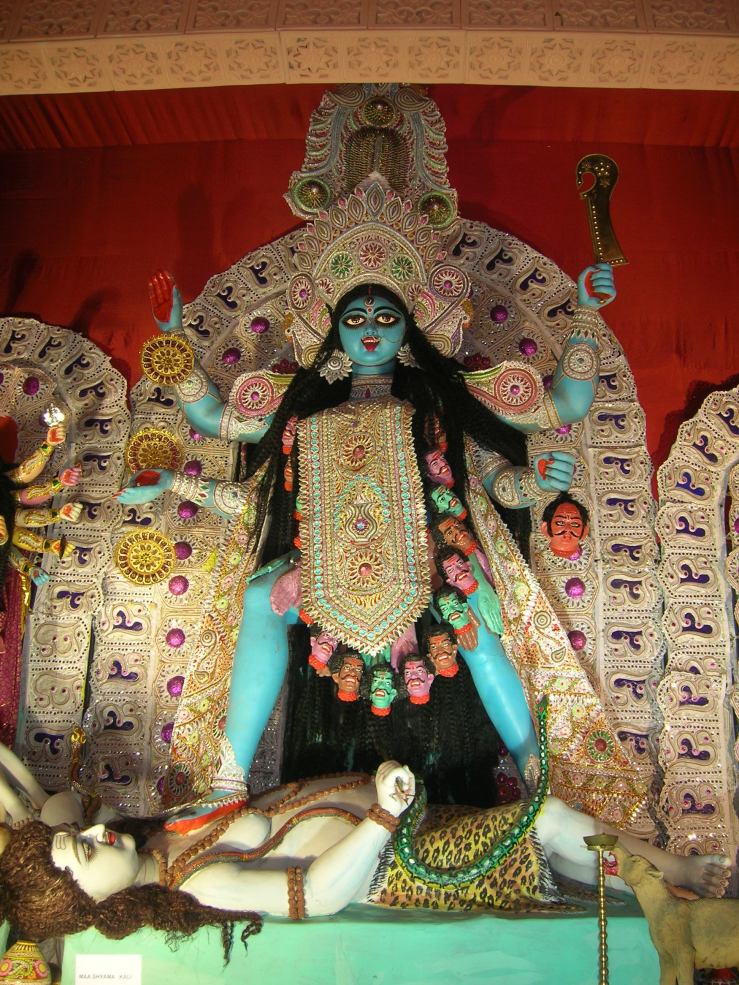
  3. viruddhavAda:To narrate imaginary attributes that are neither present by nature,and are contradictory to valid pramANas,and are illogical.Therefore statements in purANas like ‘goptA viShNu tamomUrtiH vyApAreNa tu sAttvikaH’,’tadadhIno harI sAkShAt’,(viShNu is saturated with tamoguna but sAttvika by action),(viShNu is the servant of hari),then similar statements regarding bhagavatI have been made only to evoke greater interest in devotion to shiva or bhagavatI amongst their respective literature. Or iconography showing shiva as a corpse ridden by tArA or dakShinakAlikA could also fall in that same category:As a feature of mantrashAstra meant to increase the focus on devI primarily and to emphasize her primacy in their scheme of things.

A similar analogy from mimAMsashAstra can be made regarding the statements on when to perform agnihotra:’udite juhoti’ and ‘anudite juhoti’. In the discussion on the importance of the pre-sunrise period,the post-sunrise period has been censured,and similarly during the discussion on the post-sunrise period,the pre-sunrise period has been condemned. One on the basis of this should not stop performing the ritual or perform it only once a day or vice versa,as it would result in the dosha of contrariness,let alone the dosha of not performing nityakarma. Hence,the conclusion of the shAstraj~nas has been that both have to be performed(as per the instructions received in the perceptorial line of ritualists),and it is not that one performs the sacrifice only once a day and condemns the ones who do it at other times too as inferior. Similarly by this logic the putting up of a deity(sometimes even at the cost of others) does not really mean denigration of other devatAs.

A quotation from the Brahma-saṃhitā

This text does not seem to be the popular text beloved by Gauḍīya vaiṣṇavas,but a(presumably lost) text quoted by Parāśara Bhaṭṭar,hence it is of interest to me(and looking at the Catalogue edited by Sadhu Parampurushdas,the other Brahma-saṃhitā seems to be available only in unpublished manuscript fragments featuring about matters relating to prāyaścitta and utsavas)

hṛt-padma karṇikāntasthaḥ puruṣaḥ sarvatomukhaḥ|
sarvajñaḥ sarvagaḥ sarvaḥ sarvam āvṛtya tiṣṭhati||
tasmāt tu paramaṃ sūkṣmam ākāśam bhāti nirmalam|
śuddha-sphaṭikā-saṇkāśaṃ nirvāṇaṃ paramam padam|
tatpadam prāpya tattvajñāḥ mucyante tu śubhāśubhāt||
trasareṇu-pramāṇāste raśmikoṭi vibhuṣitāḥ|
bhūyaste naiva jāyante na līyante ca te kvacit||


Rajya – a draft

Notwithstanding the opinions of the author on the divinity of Rāmacandra as an avatāra of Nārāyaṇa or his opinions on the status of the Bāla and Uttara Kāṇḍas(since I will stick to tradition here),this is still a good piece.

Heterodoxian's avatarThe Heterodoxian

The foremost selling points of democracy and universal suffrage are that it provides for stable, just governance, freedom of the populace, equal rights, equal power and thereby peaceful power transition, along with a platform to resolve differences through bipartisanship rather than through open conflict.

The US perhaps comes closest to India among all democracies in terms of population and diversity. They ended up being so polarized within a hundred years of its founding that it resulted in the nation splitting up and the two sides going to war with each other. Disagreement was resolved through conquest. Within a few decades of implementing universal suffrage and the loss of a common binding cause (the Cold War), the US again became severely polarized – the most it has been since the Civil War era according to Jonathan Haidt’s data. Worse, the two sides seem intent on demonizing the other side rather…

View original post 3,056 more words

On festivities,and proper dhārmika pomp

Just what is essential (tai/t’i) for a land and people to be a nation (kuni)? Without four limbs, a man is not a man. Similarly, a nation also possesses some essence [or requisite and defining entity that makes it a nation] (kokutai).

-Aizawa Seishisai

The soul of the Hindu nation is built on reverence to the rites(temples,yajñas,etc) and the public celebrations of our devatās. These comprise our Hindu system,which is in absolute opposition to systems from Abraham’s children(Christian,Islam,liberal,etc).

Only people who aren’t aware of the myth they are living by tell you myths can be abolished

-John Gray

Indeed. They are living the myths of liberalism,to be precise. Or other Christians/Muslims/other malicious parties using that adverse system to bait Hindus. Hence they have endless lectures for Hindus on how polluting/exploitative their festivities are(example:The dirt thrown on Dahi handi celebrations when compared to human pyramid festivities in Europe,or about polluting pandals). Or when they say about how Diwali/pandals are endless pollutants compared to 4th of July/31st December-1st January celebrations/fireworks celebrations of Bollywood celebs which invite pindrop silence to happiness from them). And have to make lots of unprincipled exceptions in their lines of arguments to specially target us. They are all side tracks to the main issue that these,as public expressions of reverence towards our devas,are matters in which no compromise should be brooked. Let us turn to Seishisai again

By worshiping Amaterasu [privately] within court enclosures, earlier emperors had offered the full measure of their sincere devotion to Her, it is true. But the significance of [earlier] emperors’ ritual acts was lost on the people below. By worshipping Amaterasu publicly, Emperor Sujin displayed his sincere devotion to the whole realm. Thus, the people grasped the significance of His Majesty’s act [directly and sensually], not through explanations or lectures…

When the Duke of Chou was praised in antiquity for having attained the “ultimate in filial devotion,” it was because everyone in the realm [joined him] in worshiping his ancestors, each person according to his proper status.The Duke of Chou did not worship his parents within ritual-hall confines, but in public, together with his people.

Similar thing can be said about Vijayadashami/Dipavali/etc celebrations. Celebrations in full dhārmika pomp and splendour,reinforcing the prescence of our devas should be made even more louder,since for us,we know and have been sustained by them for our entire civilizational length,and are the sustainers of the cosmos as seen by us,our gurus and our ṛṣis. We need not pay to people who bring up frivolous excuses to gaslight/blackmail us into reducing the dhārmika grandeur and colour of celebrations like environment,or how faith is personal. We have either these or the endless celebrations of the liberal West like Pride Month/Pride Parades/various soulless corporate dungheaps. There are no two swords in one scabbard,there is either only Indra or Vṛtra,Varāha or Hiraṇyākṣa. Similarly there is no coexistence with these systems,despite what many cloudy-visioned people may say otherwise. This was realized by far greater people than me like Tilak,who spearheaded the revival of Ganeshotsava. My standard personally for dhārmika pomp and celebrations would be the celebrations of the Mysore rājans that can be done with local groups/local rich men/grand buisiness folks at their own respective grand scales as well.


Architectural PN Oakism


Is an example of what I am talking about. Just because the shapes are similar,it does not imply an actual continuity. Actual old Bengal temples pre-Islam were mostly of the ‘deul’ types,and the sort of architecture that would go into the making of a Buddhist vihāra. Example are linked below


This style however did not entirely die out,as seen in the case of the Begunia type of temples.


The typical Bengal terracotta styles(At-chala,etc) have their basic unit/model as a small rural/village hut with a thatched roof,and the similarities with the ancient inscription should be seen as a case of convergence at best,rather than continuity,since they were built after the Islamic iconoclastic frenzy destroyed every other standing temple in Bengal/architecturally reused them for mosques,and show evidence of loss of old techniques(the designs of the murtis originating from Bengal in the medieval period itself should be evidence for this) used in Pala and Sena times.

homa vidhAnaM for nitya homa

I am uploading a homa vidhAnam I use for daily homa: nitya homa vidhAnam

Also,the keshavAdi chaturviMshati mUrti and their corresponding shaktis are

1. keshava and shrIdevI
2. nArAyaNa and lakShmI
3. mAdhava and kamalA
4. govinda and padmA
5. viShnu and padminI
6. madhusUdana and kamalAlayA
7. trivikrama and ramA
8. vAmana and vR^iSAkapiH
9. shrIdhara and dhanyA
10. hR^iShIkesha and dhanyA
11. padmanAbha and yaj~nAmbA
12. dAmodara and indirA
13. saMkarShaNa and hiraNyA
14. vAsudeva and hariNI
15. pradyumna and satyA
16. aniruddha and nityA
17. puruShottama and AnandA
18. adhokShaja and Atmaj~nA
19. nArasiMha and sukhA
20. achyuta and sugandhA
21. janArdana and sundarI
22. upendra and vidyA
23. hari and sushIlA
24. shrIkR^iShNa and sulakShaNA