The backdrop to puruShottama:shrI nIlamAdhava [A very brief note]

[I am summarizing HV Stietencorn’s work over here]. I am also assuming that the readers are familiar with the legends and lore surrounding indradyumna and puri

The indradyumna legends,like a lot of other ones of our plays and purANas is a stellar example of telescoping of multiple rulers into the activity of a single figure. Here,the activities of three rulers are telescoped into this indrdadyumna period:

  • A conqueror who builds a temple(yayAti I)
  • Settles down with his ministers in coastal Odisha(yayAti II)
  • Decay of the temple of puruShottama/nIlamAdhava(late somavaMshi period)
  • A [new] conqueror comes,finds this tradition decayed and builds a new temple for puruShottama(anantavarman choDagA~Ngadeva)

About this first temple(build between 949-959CE),we now discuss on the possibilities of the mUrti installed,which are:

  • A shilAmaya(sculpted in stone) image of nIlamAdhava standing(mostly) alone
  • A shIlAmaya image of kamalA-puruShottama(also occasionally called nIlamAdhava)
  • A dAru-rUpi(wooden) vigraha of puruShottama alone
  • A dAru-rUpi vigraha of puruShottama and shrI
  • A dAru-rUpi vigraha of puruShottama,balabhadra and subhadrA

It is found that the deities described as dAru-rUpi start appearing in literary descriptions around ga~NgA period from the 1200s onwards(passages in the skAnda and brahma purANa,tantrayAmala and mAdaLA pA~njI),which leaves us with the first two as possibilities. And out of the first two,it is the first image which is the image most likely to have been established in the first puruShottama temple of Puri,as it is the image of this type which is noted in literary sources(and plastic evidence of such images carved in bluish-black muguni stone also exist). This original nIlamAdhava is described in the brahma purANa thus

pItavastram chaturbAhuM sha~NkhachakragadAdharaM||
vanamAlAvR^itoraskaM padmapattrAyetekShaNam|
shrIvatsoraHsamAyuktam mukuTA~Ngadashobhitam||

He’s also described in the padma purANa as 4 armed,with attendants,but without any brother or sister.

An example of such an image,as in the general template above has been given from that same work to illustrate of a template to concieve of the original nIlamAdhava in the first temple to puruShottama at Puri.

shrIchakrapANaye namaH|

Dhyānas of the Aṣṭabhairavas as written according to the Rūpadhyānaratnāvalī(based on the Śrītattvanidhi)

Śrīnāgacandreśvarāya namaḥ |

The dhyānas of the aṣṭabhairavas are as follows(have also included vaṭubhairava as a sort of appendix) [I have transcribed them to the best of my ability of hearing,so kindly forgive me for any mistakes in the paṭha]

Asitānga bhairava dhyāna

sapānapātram khaḍgam ca sākṣamālākamaṇdalum||
trinetram varadam śantam kumāram ca digambaram|
brahmāṇīśaktisahitam haṃsāruḍham subhuṣaṇam||
nīlavarṇam kṛpāmūrtimasitāṇgam bhajāmyaham|

Rurubhairava dhyāna

ṭaṅkam kṛṣṇmṛgamcaiva khaḍgam pātram tathaiva ca|
trinetram varadam śāntam kumāramca digambaram||
māheśvaryā ca sahitam vṛṣārūḍham smitānanam|
śuddhāsphaṭikaśaṇkāsam namāmi rurubhairavam||

Caṇḍabhairava dhyāna

dhanurbānadharañcaiva khaḍgapātrena saṃyutam|
trinetram varadam śantam kumāram ca digambaram||
kaumāriśaktisahitam śikhivāhana bhūṣaṇam|
gauravarṇadharam devam vande’ham caṇḍabhairavam||

Krodhabhairava dhyāna

śubhacakradharam devam pānapātra gadādharam|
trinetram varadam śantam kumāram ca digambaram||
vaisṇavīśaktisahitam tārkṣyavāhana saṃyutam|
nīlavarṇamalaṃkāram vande’ham krodhabhairavam||

Unmattabhairava dhyāna

khaḍgañcamusalam caivā kheṭakam ca kapālakam|
trinetram varadam śantam kumāram ca digambaram||
hemavarṇadharam devam aśvavāhana saṃyutam|
vārāhiśaktisahitam vande’conmattabhairavam||

Kapālabhairava dhyāna

[could not understand?]vajrāyudhamcaiva khaḍgam vai pānapātrakam|
trinetram varadam śantam kumāram ca digambaram||
indrāṇīśaktisahitam gajavāhanasaṃyutam|
padmaragaprabham devam kapālam bhairavam bhaje||

Bhīṣaṇabhairava dhyāna

śulam ca mudgaraṃcaivakāpālam khaḍgahastakam|
trinetram varadam śantam kumāram ca digambaram||
cāmuṇḍāśaktisahitam harivāhana saṃyutam|
raktavarṇadharam devam vande bhīṣaṇabhairavam||

Saṃhārabhairava dhyāna

śūlam ḍamarukam caiva śaṇkham cakram gadādharam|
khaḍgaṃ pātram ca khaṭvāṇgam pāśāṇkuśadharam tatha||
daśabāhum trinetram ca sarparājopavītīnam|
digambaram kumāram ca śvānavāhanasaṃyutam||
daṃṣṭrakarālavadanāmaṣṭaiśvaryaphalapradam|
caṇḍikāśaktisahitam dhyāyet saṃhārabhairavam||

Śrī Vaṭubhairava dhyāna

vikīrṇalohitajaṭam trinetram raktavigraham|
śulam kapālam pāśañca ḍamaram dadhataṃ karaiḥ||
nānārupaiḥ piśacaiśca nānārupagaṇairvṛtam|
śvanārūḍham ca nirvāṇam vaṭukaṃ bhairavam bhaje||


shukrAchArya’s gadyam to shiva (from the shiva purANa)

… Which was composed when he was trapped in His body. He was released through mahAdeva’s shukra.

The text of the gadyam below:

oṁ namaste deveśāya surāsura namaskṛtāya bhūta bhavya mahādevāya harita piṅgala locanāya balāya buddhi rūpiṇe vaiyāghra vasanacchadāyāraṇeyāya trailokya prabhave īśvarāya harāya haritanetrāya yugāntakaraṇāyānalāya gaṇeśāya lokapālāya mahābhujāya mahāhastāya śūline mahādaṃṣṭriṇe kālāya maheśvarāya avyayāya kālarūpiṇe nīlagrīvāya mahodarāya gaṇādhyakṣāya sarvātmane sarvabhāvanāya sarvagāya mṛtyuhantre pariyātrasuvratāya brahmacāriṇe vedāntagāya tapontakāya paśupataye vyaṅgāya śūlapāṇaye vṛṣaketave haraye jaṭine śikhaṇḍine lakuṭine mahāyaśase bhuteśvarāya guhāvāsine vīṇāpaṇavatālavate amarāya darśanīyāya bālasūryanibhāya śmaśānavāsine bhagavate umāpataye arindamāya bhagasyākṣipātine pūṣṇordaśana nāśanāya krūrakartakāya pāśahastāya pralayakālāya ulkāmukhāyāgniketave munaye dīptāya viśāṃpataye unnayate janakāya caturthakāya loka sattamāya vāmadevāya vāgdākṣiṇyāya vāmato bhikṣave bhikṣurūpiṇe jaṭine svayaṃ jaṭilāya śakrahastapratistaṃbhakāya vasūnāṃstaṃbhāya kratave kratukarāya kālāya medhāvine madhukarāya calāya vānaspatyāya vājasaneti samāśramapūjitāya jagaddhātre jagadkartre puruṣāya śāśvatāya dhruvāya dharmādhyakṣāya trivartmane bhūtabhāvanāya trinetrāya bahu rūpāya sūryāyutasamaprabhāya devāya sarvatūryaninādine sarvabādhāvimocanāya bandhanāya sarvadhāriṇe dharṃmottamāya puṣpadantāyāpi bhāgāya mukhāya sarvaharāya hiraṇyaśravase dvāriṇe bhīmāya bhīmaparākramāya oṁ namo namaḥ


Credits to @pinakasena

On Adi sha~Nkara’s theism

Ghora: My conclusion (in short):

1. shaMkara had no qualms with either shiva or viSNu being kAryabrahman or a saguNa symbol of the Atman he held as the highest reality. He was not your tear-jerking bhakta so favoured by the sectarian devotees of this or that deity. He didn’t particularly care about this issue. In the entire analysis I have restricted myself to quoting works which are unanimously held to be authored by him. No stotras, not even his independent works. His BSB, BGB & UpBs(brahmasutrabhAShya,bhagavadgItAbhAShya, upaniShad bhAShyas) That’s all

2. He may not have been comfortable with the existing, dominant shaiva sects of his time (pAshupatam or caturbhagini worship). In this light, please do not that there is an extremely famous bauddha mantra which invoked protection against various “dangerous” beings, including the caturbhaginis.

3. shaMkara was most likely not exposed to the mild siddhAnta form (I have issues with his dating but this is a different story)
Me: Why do you think so about (3)?

Ghora: Forgot to send u the main portion: Here are all the facts abt shaMkara’s theism:

1. shaMkara had a very dry conception of “brahman”, whom he clearly distinguishes from viSNu by the use of an interesting simile in the BSB.

2. There is the high possibility that he quotes a mantra from the kaivalyopaniSat at the start of his aitareyopaniSadbhASya. As you know, the kaivalyopaniSat is unabashedly shaiva In orientation.

3. He definitely quotes the shvetashvataropaniSat in his BSB; which you also know that gives a valid basis for shiva being parabrahman.

4. In his bhASya on kenopaniSat, where umA haimavatI “schools” indra & others, how does he gloss on the shruti’s description of umA devI—“bahushobhamAnAm umAM haimavatIm”. That gloss itself is very telling.

There are two bhASyas on kena. But still, both are telling. In one, he simply says that she is rudrapatnI who is brahmavidyA herself. In the other, he says that she is ever in contact with the sarvajña īśvara.

5. It is true that while he rejects all systems “outside” the veda: yoga, sAMkhyA, pāśupata & pāñcarātra, his treatment of pāñcarātra seems to be the kindest, where he says that he does not condemn their rituals but only their faulty metaphysics.

6. In his gItAbhASya, he gives vinAyakas, saptamAtRkas & caturbhaginis as examples of bhUtas. He doesn’t say that one shouldn’t worship them but he gives bhUtas as an example of tAmasika worship. Now points 5 & 6 have been milked for all it is worth by SVs without appreciating the context or appreciating the weight of points 1-4.

Me : Yes

Ghora: 3 is because the siddhAnta was far from well-known in the 600s/700s (I’m inclined to date earlier tbf)…Even around the 600s (appar), it was still a fledgling movement with pAshupatas possibly still being the dominant group
Ghora: The four main maThas were built in places in eras when the siddhAnta simply was not present there….

His dwelling in kAnchi & kAshmIra are generally considered hagiographic excesses

My own note: The simile in question from the brahmasutrabhAShya is ईदृशं चात्र ब्रह्मण उपास्यत्वं यतः प्रतीकेषु तत्दृष्ट्याध्यारोपणं प्रतिमादिषु इव विष्ण्वादीनाम्।(īdṛśaṃ cātra brahmaṇa upāsyatvaṃ yataḥ pratīkeṣu tatdṛṣṭyādhyāropaṇaṃ pratimādiṣu iva viṣṇvādīnām। For those who can’t read devanAgarI).

Things I found interesting for various reasons in the shivapurANa in my casual study of it

vidyeshvarasaMhitA

  1. 13.54-55-j~nAna acquired through tapasyA was recommended in satyayuga,treta too tapasyA,sacrifice in the dvApara and mUrti-pUjA in kaliyuga
  2. 13.72-73 How to utilize one’s earned artha:Divide it into three parts,1/3rd for dharma(nitya,naimittika and kAmya karmas),1/3rd for vR^iddhi(increase wealth),1/3rd for bhoga(enjoy the wealth in pure/legitimate ways)
  3. 14.35 To ward off apamR^ityu,homa with gingelly seeds to rudra should be done on Saturdays
  4. 16.21 Propitiating vinAyaka is a way to have all of one’s wishes granted. Especially good days to begin His worship are Fridays,4th day of shuklapakSha of shrAvanamAsa+bhAdra+shatabhisha nakShatra in dhanurmAsa/worshipped continuously for 100 or 1000 days.
  5. 23:Glorification of shivanAma
  6. 24:Greatness of bhasma
  7. 25.43 A shivabhakta should refrain from meat,garlic,onion,red garlic,pork,liquors.
  8. 25.76 A 10-faced rudrAkSha is emblematic of janArdana(viShNu),and is worn by the mantra OM hrIM namaH

rudrasaMhitA

  1. 4.45 The name shiva blazing like a forest fire reduces mountains of heaps of great sins to ashes effortlessly
  2. 4.50-54 shiva’s names glorified
  3. 4.57 ekAntika bhakti to shiva and not any other else advised by nArAyaNa
  4. 6.20 IshvarashaktI—>pradhAna/prakR^iti/mAyA
  5. 21.8 She is 8 armed,face with splendour of 1000 moons,with 1000s of stars around Her face
  6. 6.33-38 Both shiva and viShNu have the ability to give mokSha
  7. 13th chapter:A shiva pUjA vidhi which has no restrictions as far as I could see(as none of the mantras are vaidika)
  8. 14.36:-Except champaka/ketaka,all other flowers can be used to worship mahAdeva.
  9. 29.48 The syllables ‘shi’ and ‘va’ said together even once casually dispel all sins.
  10. 33.11/12 mahAkAlI sets out with vIrabhadra to destroy dakSha’s yaj~na accompanied by 9 durgAs:kAlI,kAtyAyanI,IshAnI,chAmuNDA,muNDamAlinI,bhadrakAlI,bhadrA,tvaritA and vaiShNavI
  11. 33.31-32 The purANa notes that even those who depend on knowledge,eschewal of IshvarabhaktI is going to make them fall into naraka and remain there for hundreds of crores of kalpas. Those who solely depend on action are bound by its nooses,born in lives after lives and are finally scorched and tormented in hells.
  12. 36.66-Another instance of hariharAbheda
  13. 37.49:-vIrabhadra cuts off sarasvatI’s nose-tip
  14. 38.34:-An inteteresting dhyAna

shatarudrasaMhitA

  1. 9.15 ‘He who repeats mahAdeva’s names is freed from the bondage of the body he has acquired’
  2. 9.34 ‘Even after committing a great sin if a person remembers Hin who is the AdhAra and support of the worlds,his sins are quelled’
  3.  16:-The tale of the kenopanishad retold for suggesting shivaparatvam(as yakSheshvara)
  4. 17th chapter:-A late interpolation(it knows of a text tantrasAra+a non-shaiva appearance on a predominantly distinctly smArta shaiva text,featuring mahAvidyAs)

koTirudrasaMhitA

  1.  7th chapter:R^iShikA the chaste brahmin widow asks for two things:That She be forever devoted at rudra’s feet+to stay permanently at the spot of Her penance

9th chapter:How a woman attains good by uttering shivanAma unwittingly.

umAsaMhitA

  1. 20.47-54(Particularly 50,51 and 52nd shlokas of this adhyaya):Those who repeat the names of shiva need not be afraid of hell or yama. The two syllables of ‘shiva’ constitute the packet of food required for paralokagamana.It is the means of mokSha free from worries and the abode of all merits. It is only the nAma of shiva that subdues and quells the ocean of karmans.
  2. 42nd chapter contains a praise of shiva nAMa as well,and some other details.

kaliAsasaMhitA

  1. 11th chapter(shloka 22-37):vAmadeva’s stuti to skanda,beloved of gajavalli
  2. 13.62:shiva utters the praNava to those who die in kAshi and they get liberated
  3. 32nd chapter is a kinda a pAshupatayoga sort of chapter.It specifically calls its rite the nAmAShTakayoga(and explains the names involved).It’s also aware of the siddhAnta(mentions kAmikAgAma by name).
  4. Chapter 34-35:An account of the prince of shivabhaktas amongst the R^ishis upamanyu. upamanyu is the son of the sage vyAghrapAda. upamanyu at the end prays for devotion and always being near umAdhava.
  5.  Part 2 of the kailAsa saMhitA: Chapter 2,the kenopanishadic tale is repeated
  6.  Part 2:Chapter 11.27-37:Description of features of shivabhaktas
  7.  Part 2: Chapter 11.53-54 Speaking on the imporatance of concentrating the mind on mahAdeva by any means
  8.  Part 2: Chapter 12.37 A person who is steady in the japa of the pa~nchAkShara is released from sins whether he be a shudra,a person of a low birth,a fool or a learned man.
  9. Part 2:Chapter 13:Greatness of the pa~nchAkSharI
  10.  Part 2:Chapter 14.62-74 was what I noted as highly interesting.
  11.  Part 2:Chapter 25.63: O kR^iShNa,a low born,base or a fool if he resorts to shiva is worthy of being worshipped by devas and asuras.
  12.  Part 2:Chapter 43:A dhyAna of agnideva.Three feet,seven hands,4 horns,two heads,3 eyes per head,with matted hair,moon on crest,tawny as honey,with red garments,holding sruc,sruva,club,fan,vessel of ghee

Personal note:The most complete dhyAna of agni I have seen is this one

sapta hastaH chatuH shrR^i~NgaH sapta jihvo dvi shlrShakaH|
tripAt.h prasanna vadanaH sukhAsInaH shuchi smitaH||
svAhAM tu daxiNe pArshve devIM vAme svadhAM tathA |
bibhrat.h daxiNa hastaistu shaktimannaM sruchaM sruvaM ||
tAmaraM vyajanaM vAmaiH ghR A itapAtraM cha dhArayan.h|
meShArDho jaTAbaddho gauravarNo mahau jasaH ||
dhrUmra dhvajo lohitAxaH saptArchiH sarvakAmadaH ||
AtmAbhimukhamAsInaH evaM rUpo hutAshanaH II


-iti shivaM-

On mAnasika pUjA

https://twitter.com/Better_Not_Shar/status/1133063165472755719

mAnasika pUjA is not a substitute for the external rituals. Are we yogis that we can ignore/shut out all sensory inputs from our various indriyas and surroundings and do the pUjA in our current states just mAnasika?An example of how all the senses were directed towards nArAyaNa is the example of mahArAja ambarISha given in the link.(Using the ISKCON translation because I am lazy)

sa vai manaḥ kṛṣṇa-padāravindayor
vacāṁsi vaikuṇṭha-guṇānuvarṇane
karau harer mandira-mārjanādiṣu
śrutiṁ cakārācyuta-sat-kathodaye
mukunda-liṅgālaya-darśane dṛśau
tad-bhṛtya-gātra-sparśe ‘ṅga-saṅgamam
ghrāṇaṁ ca tat-pāda-saroja-saurabhe
śrīmat-tulasyā rasanāṁ tad-arpite
pādau hareḥ kṣetra-padānusarpaṇe
śiro hṛṣīkeśa-padābhivandane
kāmaṁ ca dāsye na tu kāma-kāmyayā
yathottamaśloka-janāśrayā ratiḥ

Mahārāja Ambarīṣa always engaged his mind in meditating upon the lotus feet of Kṛṣṇa, his words in describing the glories of the Lord, his hands in cleansing the Lord’s temple, and his ears in hearing the words spoken by Kṛṣṇa or about Kṛṣṇa. He engaged his eyes in seeing the Deity of Kṛṣṇa, Kṛṣṇa’s temples and Kṛṣṇa’s places like Mathurā and Vṛndāvana, he engaged his sense of touch in touching the bodies of the Lord’s devotees, he engaged his sense of smell in smelling the fragrance of tulasī offered to the Lord, and he engaged his tongue in tasting the Lord’s prasāda. He engaged his legs in walking to the holy places and temples of the Lord, his head in bowing down before the Lord, and all his desires in serving the Lord, twenty-four hours a day. Indeed, Mahārāja Ambarīṣa never desired anything for his own sense gratification. He engaged all his senses in devotional service, in various engagements related to the Lord. This is the way to increase attachment for the Lord and be completely free from all material desires.


All these to keep one’s mind while doing the ritual of pUjA,japa,etc to establish the prescence of the devatA in the mind. Are those who claim mAnasika pUjA can be done merely due to lack of effort in shuchi/correct dravya/ityAdi yogins /have reached that quality of being absorbed in your devatA all your time?If yes,I have no objections.

On Hotee Vidyalankar and other learned brAhmaNa ladies

Copying from Halley Gowami because some things deserve a more permanent media than a Facebook post

18815165_1379391695464085_8999940936417102641_o

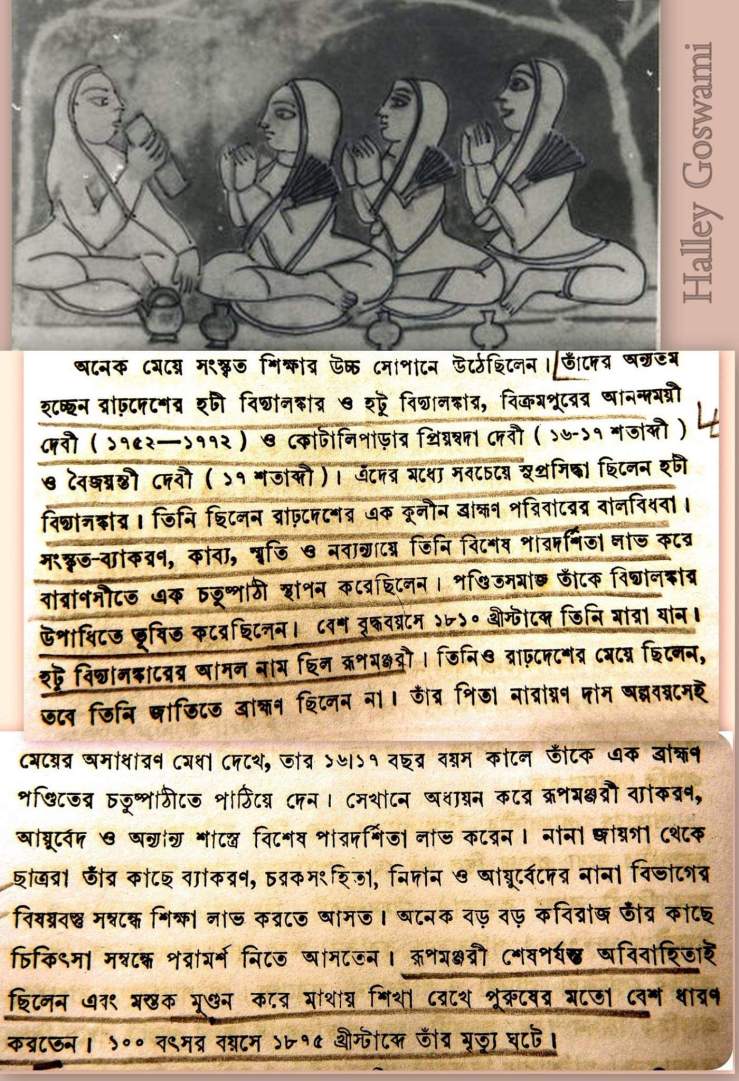
” Some ladies recieved higher education and managed to rise to great hieghts ! Amongst such rare women , Hotee Vidyalankar , Hotu Vidyalankar , Anandamayee Devi (1752 — 1772) and Priyamvada Devi (16th cent–17th cent) stands out .
Hotee Vidyalankar was the most famous of them all . Born to ‘kulin’ brahmin family she was a widow from childhood . She became an authority on Sanskrit grammer , poetry , Smriti , Navya-nyay and established her own ‘chatuspathi’ ( centers of higher learning ) at Varanasi ! Brahman Pandits bestowed her with the title of Vidyalankar . She died at an advanced age in the year 1810 .

Hotu Vidyalankar’s real name was Rupamanjari . She was not a brahmin , but her father , Narayan Das noticed her exceptional intellgence and sent her at the ‘chatuspaathi’ of a brahmin pandit . There Rupamanjari mastered Ayurved , Grammer and other branches of studies . Her fame spread far and wide and students used to come from far off places to learn or get opinions on Ayurved , charak samhita and grammer . Ayurvedic doctors of the age used to consult her on matters of medicine ! Rupamanjari never married and kept her head shaven with a ‘shikha’ ( Chuda / tuft of hair ) and dressed as a man . She died 100 years of age at 1875 . ”

Someone in the comments mentions that Narayan Sanyal wrote a book রূপমঞ্জরী on haTI vidyAla~Nkara.


Āgāmavāgiśa’s dhyānas from Bṛhat Tantrasāra that more closely match the Kālī mūrtis in Bengal than the one popularly recited

The one that is ‘popularly recited’ in many places runs

करालवदनां घोरं मुक्तकेशीं चतुर्भुजं । कालिका दक्षिणां दिव्यां मुण्डमाला विभूषिता ।।
सद्यछिन्नशीरा खड्ग वामदोर्ध्व कराम्बुजं । अभयंवरदं चैव दक्षिणोर्ध्वद पाणिकं ।।
महामेघप्रभां श्यामां तथा चैव दिगम्बरीं । कंठावासक्त मुण्डाली गलद्रधीर चर्चिताम् ।।
कर्णावतं सतानीत शवयुग्म भयानकं । घोरदंष्ट्राम करालस्याम् पीनोन्नत पयोधराम् ।।
शवानं करसंघाती कृतकंची हसन्मुखी । सृक्कद्वया गलद्रक्त धाराविस्फ़ुरिटाननां ।।
घोररावा महारौद्रिं शमशानालय वसिनिं । बालार्कमण्डलाकारं लोचनं त्रितयान्वितां ।।
दनतुरं दक्षिणं व्यापि मुक्तलन्विक चोचयां । शवरुप महादेव हृदयोपरि संस्थितं ।।
शिवाभिर्घोररावाभिश्चतुर्दिक्षु समन्वितां । महाकालेन च सामं विपरित रातातुरां ।।
सुखप्रसन्न वदनां स्मेरनानना सरोरूहं । एवं संचिन्तयेत् काली धर्मकामार्थसिद्धिदा ।।

karālavadanāṃ ghoraṃ muktakeśīṃ caturbhujaṃ । kālikā dakṣiṇāṃ divyāṃ muṇḍamālā vibhūṣitā ।।
sadyachinnaśīrā khaḍga vāmadordhva karāmbujaṃ । abhayaṃvaradaṃ caiva dakṣiṇordhvada pāṇikaṃ ।।
mahāmeghaprabhāṃ śyāmāṃ tathā caiva digambarīṃ । kaṃṭhāvāsakta muṇḍālī galadradhīra carcitām ।।
karṇāvataṃ satānīta śavayugma bhayānakaṃ । ghoradaṃṣṭrāma karālasyām pīnonnata payodharām ।।
śavānaṃ karasaṃghātī kṛtakaṃcī hasanmukhī । sṛkkadvayā galadrakta dhārāvisफ़uriṭānanāṃ ।।
ghorarāvā mahāraudriṃ śamaśānālaya vasiniṃ । bālārkamaṇḍalākāraṃ locanaṃ tritayānvitāṃ ।।
danaturaṃ dakṣiṇaṃ vyāpi muktalanvika cocayāṃ । śavarupa mahādeva hṛdayopari saṃsthitaṃ ।।
śivābhirghorarāvābhiścaturdikṣu samanvitāṃ । mahākālena ca sāmaṃ viparita rātāturāṃ ।।
sukhaprasanna vadanāṃ smeranānanā sarorūhaṃ । evaṃ saṃcintayet kālī dharmakāmārthasiddhidā ।।

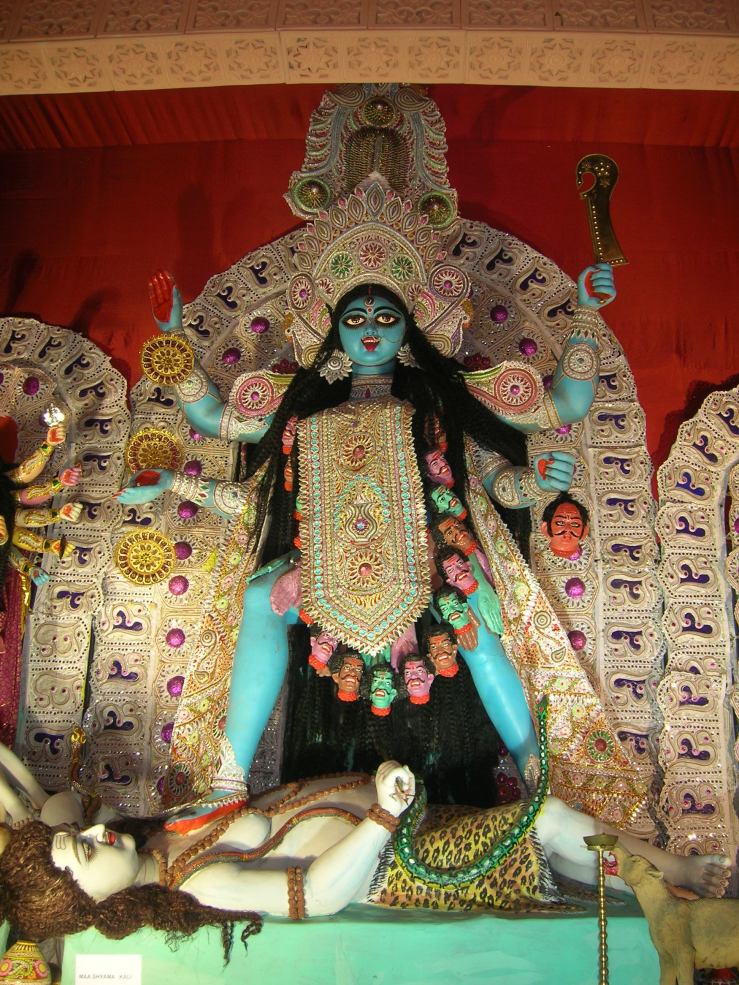
The source of this in the Bṛhat Tantrasāra(hence called BTS in short) is the Kālītantra…and although this is popularly recited and some people say that Āgāmavāgiśa composed this dhyāna,I have hardly seen Kālī mūrtis that conform to the above lakṣaṇas.

In fact,the Kālī mūrtis I’ve seen in houses and temples conform much closer to the dhyānas laid down below(also from BTS)

शवारुढां महाभीमं घोरदंष्ट्रां वरप्रदां। हास्ययुक्तां त्रिनेत्राङ्च कल्पाल-कर्तृक-करां॥
मुक्त-केशिं ललज्-जिह्वां पिबन्तिम् रुधिरम् मुहुः। चतुर्बाहुयुतम् देवीं वराभयकरां स्मरेत्॥

śavāruḍhāṃ mahābhīmaṃ ghoradaṃṣṭrāṃ varapradāṃ। hāsyayuktāṃ trinetrāṅca kalpāla-kartṛka-karāṃ॥
mukta-keśiṃ lalaj-jihvāṃ pibantim rudhiram muhuḥ। caturbāhuyutam devīṃ varābhayakarāṃ smaret॥

This is from the Siddheśvara tantra. This dhyāna can be followed alone by those who have recieved initiation in Kālī’s single-syllabled vidyā.

Then the dhyāna which conforms to the popular depictions I have seen everywhere(also from BTS) with much less ambiguity(as to the hand positions)

देवी वामोर्द्वाधोहस्ते खड्ग-मुण्डञ्च पूजयेत्।
देव्या दक्ष-हस्तोर्ध्वाधः पूजयेद् अभयं वरम्॥

devī vāmordvādhohaste khaḍga-muṇḍañca pūjayet।
devyā dakṣa-hastordhvādhaḥ pūjayed abhayaṃ varam॥

Dakshina_Kali_Shakespeare_Sarani_Arnab_Dutta_2011

(Image original link: )

This is from the Kālīhṛdaya.

If one is saying that Āgāmavāgiśa ‘popularized’ Kālī,it is this dhyāna that matches. Caveat:Not do raise doubts on the siddha,but I am unaware if Kālīhṛdaya is his own work or not.


Brahmā’s praise of Nārāyaṇa to take up Hayagrīva rūpa to kill Madhu and Kaiṭabha from the Mahābhārata(Śāntiparvan)

unnamed

Hayagrīva slaying an asura(Kalighat painting)

brahmovāca।
oṃ namaste brahmahṛdaya namaste mama pūrvaja ।
lokādyabhuvanaśreṣṭha sāṅkhyayoganidhe prabho ॥
vyaktāvyaktakarācintya kṣemaṃ panthānamāsthitaḥ ।
viśvabhuksarvabhūtānāmantarātmannayonija ।
ahaṃ prasādajastubhyaṃ lokadhāma svayaṃbhuvaḥ ॥
tvatto me mānasaṃ janma prathamaṃ dvijapūjitam ।
cākṣuṣaṃ vai dvitīyaṃ me janma cāsītpurātanam ॥
tvatprasādāttu me janma tṛtīyaṃ vācikaṃ mahat ।
tvattaḥ śravaṇajaṃ cāpi caturthaṃ janma me vibho ॥
nāsatyaṃ cāpi me janma tvattaḥ pañcamamucyate ।
aṇḍajaṃ cāpi me janma tvattaḥ ṣaṣṭhaṃ vinirmitaṃ ॥
idaṃ ca saptamaṃ janma padmajanmeti vai prabho ।
sargesarge hyahaṃ putrastava triguṇavarjita ॥
prathamaḥ puṇḍarīkākṣaḥ pradhānaguṇakalpitaḥ ।
tvamīśvaraḥ svabhāvaśca bhūtānāṃ tvaṃ prabhāvana
tvayā vinirmito’haṃ vai vedacakṣurvayotiga ।
te me vedā hṛtāścakṣurandho jātosmi jāgṛhi ।
dadasva cakṣūṃṣi mama priyo’haṃ te priyosi me ॥

In Devanagari

ब्रह्मोवाच।
ॐ नमस्ते ब्रह्महृदय नमस्ते मम पूर्वज ।
लोकाद्यभुवनश्रेष्ठ साङ्ख्ययोगनिधे प्रभो ॥
व्यक्ताव्यक्तकराचिन्त्य क्षेमं पन्थानमास्थितः ।
विश्वभुक्सर्वभूतानामन्तरात्मन्नयोनिज ।
अहं प्रसादजस्तुभ्यं लोकधाम स्वयंभुवः ॥
त्वत्तो मे मानसं जन्म प्रथमं द्विजपूजितम् ।
चाक्षुषं वै द्वितीयं मे जन्म चासीत्पुरातनम् ॥
त्वत्प्रसादात्तु मे जन्म तृतीयं वाचिकं महत् ।
त्वत्तः श्रवणजं चापि चतुर्थं जन्म मे विभो ॥
नासत्यं चापि मे जन्म त्वत्तः पञ्चममुच्यते ।
अण्डजं चापि मे जन्म त्वत्तः षष्ठं विनिर्मितं ॥
इदं च सप्तमं जन्म पद्मजन्मेति वै प्रभो ।
सर्गेसर्गे ह्यहं पुत्रस्तव त्रिगुणवर्जित ॥
प्रथमः पुण्डरीकाक्षः प्रधानगुणकल्पितः ।
त्वमीश्वरः स्वभावश्च भूतानां त्वं प्रभावन
त्वया विनिर्मितोऽहं वै वेदचक्षुर्वयोतिग ।
ते मे वेदा हृताश्चक्षुरन्धो जातोस्मि जागृहि ।
ददस्व चक्षूंषि मम प्रियोऽहं ते प्रियोसि मे ॥

Copypasting Ganguli’s translation(since I’m very short on time): http://www.sacred-texts.com/hin/m12/m12c047.htm

“Brahma said, ‘I bow to thee, O heart of Brahman. I bow to thee that hast been born before me. Thou art the origin of the universe. Thou art the foremost of all abodes. Thou, O puissant one, art the ocean of Yoga with all its branches. Thou art the Creator of both what is Manifest and what is Unmanifest. Thou treadest along the path whose auspiciousness is of inconceivable extent. Thou art the consumer of the universe. Thou art the Antaralock (Inner Soul) of all creatures. Thou art without any origin. Thou art the refuge of the universe. Thou art self-born; for origin thou hest none that is not thyself. As regards myself, I have sprung through thy Grace. From thee have I derived my birth. My first birth from thee, which is regarded sacred by all regenerate persons, was due to a fiat of thy Mind. My second birth in days of yore was from thy eyes. Through thy Grace, my third birth was from thy speech. My fourth birth. O puissant Lord, was from thy ears. My fifth birth, excellent in all respects, was from thy nose. O Lord, My sixth birth was, through thee, from an egg. This is my seventh birth. It has occurred, O Lord, within this Lotus, and it is meant to stimulate the intellect and desires of all the beings. At each Creation I take birth from thee as thy son, O thou that art divested of the three attributes. Indeed, O lotus-eyed one, I take birth as thy eldest son, made up of Sattwa the foremost of three attributes. Thou art endued with that nature which is Supreme. Thou springest from thyself. I have been created by thee. The Vedas are my eyes. Hence, I transcend Time itself. Those Vedas, which constitute my eyes, have been taken away from me. I have, therefore, become blind. Do Thou awake from this Yoga-sleep. Give me back my eyes. I am dear to thee and thou art dear to me.

For shivarAtri:arjuna with shiva kirATa,along with his hymn to him(from the Mahabharata,vana parva)

Screenshot_2019-03-03_19-21-42


From the Vana Parva,text of arjuna’s stotra along with Ganguli’s translation(Am using the Kumbhakonam recension)

kapardinsarvabhūteśa bhaganetranipātana ।
[devadeva mahādeva nīlagrīva jaṭādhara ॥ 3-39-74 (17332)
kāraṇānāṃ ca paramaṃ jāne tvāṃ tryambakaṃ vibhum ।
devānāṃ ca gatiṃ devaṃ tvatprasūtamidaṃ jagat ॥ 3-39-75 (17333)
ajeyastvaṃ tribhirlokaiḥ sadevāsuramānuṣaiḥ ।
śivāya viṣṇurūpāya viṣṇave śivarūpiṇe ॥ 3-39-76 (17334)
dakṣiyajñavināśāya harirūpāya te namaḥ ।
lalāṭākṣāya śarvāya mīḍhuṣe śūlapāṇaye ॥ 3-39-77 (17335)
pinākagoptre sūryāya maṅgalyāya ca vedhase ।
prasādaye tvāṃ bhagavansarvabhūtamaheśvara ॥ 3-39-78 (17336)
gaṇeśaṃ jagataḥ śambhuṃ lokakāraṇakāraṇam ।
pradhānapuruṣātītaṃ paraṃ sūkṣmataraṃ haram ॥ 3-39-79 (17337)
vyatikramaṃ me bhagavankṣantumarhasi śaṃkara ।
bhagavandarśanākāṅkṣī prāptosmīmaṃ mahāgirim ॥ 3-39-80 (17338)
dayitaṃ tava deveśa tāpasālayamuttamam ।
prasādaye tvāṃ bhagavansarvalokanamaskṛtam ॥ 3-39-81 (17339)
kṛto mayā’yamajñānādvimardo yastvayā saha ।
śaraṇaṃ pratipannāya tatkṣamasvādya śaṃkara ॥

कपर्दिन्सर्वभूतेश भगनेत्रनिपातन ।
[देवदेव महादेव नीलग्रीव जटाधर ॥ ३-३९-७४ (१७३३२)
कारणानां च परमं जाने त्वां त्र्यम्बकं विभुम् ।
देवानां च गतिं देवं त्वत्प्रसूतमिदं जगत् ॥ ३-३९-७५ (१७३३३)
अजेयस्त्वं त्रिभिर्लोकैः सदेवासुरमानुषैः ।
शिवाय विष्णुरूपाय विष्णवे शिवरूपिणे ॥ ३-३९-७६ (१७३३४)
दक्षियज्ञविनाशाय हरिरूपाय ते नमः ।
ललाटाक्षाय शर्वाय मीढुषे शूलपाणये ॥ ३-३९-७७ (१७३३५)
पिनाकगोप्त्रे सूर्याय मङ्गल्याय च वेधसे ।
प्रसादये त्वां भगवन्सर्वभूतमहेश्वर ॥ ३-३९-७८ (१७३३६)
गणेशं जगतः शम्भुं लोककारणकारणम् ।
प्रधानपुरुषातीतं परं सूक्ष्मतरं हरम् ॥ ३-३९-७९ (१७३३७)
व्यतिक्रमं मे भगवन्क्षन्तुमर्हसि शंकर ।
भगवन्दर्शनाकाङ्क्षी प्राप्तोस्मीमं महागिरिम् ॥ ३-३९-८० (१७३३८)
दयितं तव देवेश तापसालयमुत्तमम् ।
प्रसादये त्वां भगवन्सर्वलोकनमस्कृतम् ॥ ३-३९-८१ (१७३३९)
कृतो मयाऽयमज्ञानाद्विमर्दो यस्त्वया सह ।
शरणं प्रतिपन्नाय तत्क्षमस्वाद्य शंकर ॥

[O Kapardin, O chief of all gods, O destroyer of the eyes of Bhaga, O god of gods, O Mahadeva, O thou of blue throat, O thou of matted locks, I know thee as the Cause of all causes. O thou of three eyes, O lord of all! Thou art the refuge of all the gods! This universe hath sprung from thee. Thou art incapable of being vanquished by the three worlds of the celestials, the Asuras, and men. Thou art Siva in the form of Vishnu, and Vishnu in the form of Siva. Thou destroyedest of old the great sacrifice of Daksha. O Hari, O Rudra, I bow to thee. Thou hast an eye on thy forehead. O Sarva, O thou that rainest objects of desire, O bearer of the trident, O wielder of the Pinaka, O Surya, O thou of pure body, O Creator of all, I bow to thee. O lord of all created things, I worship thee to obtain thy grace. Thou art the lord of the Ganas, the source of universal blessing, the Cause of the causes of the universe. Thou art beyond the foremost of male beings, thou art the highest, thou art the subtlest, O Hara! O illustrious Sankara, it behoveth thee to pardon my fault. It was even to obtain a sight of thyself that I came to this great mountain, which is dear to thee and which is the excellent abode of ascetics. Thou art worshipped of all worlds. O lord, I worship thee to obtain thy grace. Let not this rashness of mine be regarded as a fault–this combat in which I was engaged with thee from ignorance. O Sankara, I seek thy protection. Pardon me all I have done.]