The greatness of the name of Durga (as uttered in the rudrayAmala tantra and muNDamAlA tantra mainly)

Copied from here,since I wanted to give the post a more permanent home.


jagaddhAtrI_shAntipur

shivovAcha :

durgA nAma japo yasya kim tasya kathayAmi te /
aham panchananaH kAnte tajjapA deva suvrate//

shiva said to pArvati

O devI, how could I narrate the glory of the name ‘durgA’?
It is because of the recitation of durgA nAma ( durgA’s name) that I am called pa~nchAnana.

dhanI putri tathA nyAni chira~njIvI bhaved bhuvi /
pratyaham yo japed bhaktyA shatam ashtottaram shuciH//

One who recites the name of durgA 108 times every day, is blessed with prosperity, offspring, wisdom and longevity.

aShTottaram sahasram tu yo japed bhakti samyutAH/
pratyaham parameshAnI tasya puNya phalam shR^iNu//
dhanArthi dhanamApnoti j~nAnArtthI j~nAnameva cha/
rogArto muchyatE rogAt baddho muchyate bandhanAt//
bhIto bhayAt muchyate pApAn muchyate pAtakI/
putrArthi labhate putram devI satyam na saMshayaH//

One who recites the name of durgA 1008 times daily with great reverence will be blessed with whatever he asks for. Those who in dire need for financial aid will be blessed with all round prosperity, one who longs for wisdom will be blessed with nyAnA sampat, the one who suffers from ailments shall be relieved from their ailments,One who is desirous of progeny will be blessed with putra lAbha and the one who is in fear is relieved from his fears. One who has been imprisoned will be set free, if he repents and recites the name of durga 1008 times daily with faith and devotion. All the sins are absolved by reciting durgA nAma.

evam satyam vijAnIhi samartha sarva karmasu/
Ayutam yo japet bhaktyA pratyAham paramEshwarI//
nigrahAnugrahe shaktA sa bhavEd kalpapAdapA/
tasya krodhe bhaven mR^ityu prasAde paripUrnatA//

If one recites Her name 10,000 times, he is blessed with the ability to bless and curse and will be a living wish fulfilling tree (kalpataru). In his anger there is death and in his pleasantness there is fulfillment.

mAsi mAsi cha yo lakshaM japam kuryAd varAnanE/
na tasya graha pIdA tasya kadachid api shAnkarI//
nachaishwaryam kshayam yati nacha sarpa bhayam bhavet/
nagni chaura bhayam vApi charanye jale bhayam//
parvatArhane napi simham vyAgra bhayam tathA/
bhUta preta pishAchAnAm bhayam nApi bhavet kvachit//
na cha vairi bhayam kAnte napi dushta bhayam bhavet/
paraloke bhavet swargIm satyam vai vIra vandite//
chandra sUrya samudbhUtvA vashet kalpAyutam divi/
vAjapeya sahasrasya yat phalam syAd varAnane//
tatphalam samAvApnotI durgA nAma japAt priye/
na durgam nAma sadR^isham nAmAstI jagati tale//
tasmAt sarva prayatnena smartavyam sAdhakottamaiH/
yasyA smarana mAtrena palayante mahApada//

One who recites her name 100,000 (in a month), will not be troubled by malefic planets, his wealth never diminishes, there will no fear for snakes, fire, thieves, enemies,forest or water. While mountaineering there will be no fear/ trouble of tigers, lions, demons or evil entities. He will be ever blissful and will attain the highest abode of the dEvAs (heaven) in his afterlife. He shall remain in heaven as long as the sun and moon exist. To him accrues the benefit of 1000 vAjapEya yagnAs. There is no name that can be compared to the greatness of durgA nAma in the whole universe. Difficulties and sufferings disappears the moment one remembers Her divine name.

(rudrayAmalam) [From the rudra yAmala]

The image in this blog is the one of the beautiful Jagaddhatri Durga of the Brahmachari family of Shantipur.

More sources(from the page: দুর্গালোকনিবাসিনী শ্রীমদদুর্গতিনাশিনী মহামহিষাসুরমর্দিনী দেবীমা): In here,it is said in shAstra that for one who does japa of durgA nAma:his shiva comes with His shUla,viShNu with His chakra,indra with His vajra,etc. And it is a name of great power/shakti. Brahma gained the power of creation by this name,shiva reached His high state by smaraNa(remembrance) of this name,and this name is the secret of all the strength of the respective deities in their fields. One who remembers this name at the end gains sAyujya mukti with devI even if he was a great sinner his whole life.

Then from here it cites a shloka

daityanAshArthabachano dakAraH parikIrtitaH|
ukAro vighnanAshasya vAchako vedasammata||
repho rogaghnavachano gashcha pApaghnavAchakaH|
bhayshatrughnavachanashchAkAraH parikIrtitaH||

In the name of ‘durgA’, ‘da’ kAra is daityanAshaka, ‘u’kAra is vighnanAshaka,’ga’kAra is pApanAshaka,’A’kAra is shatrunAshaka. The one who destroys daityas,vighnas(difficulties),sins and enemies is durgA. The page then goes into a brief discussion of daiva and asuri sampat(those qualities) and which Durga destroys in the sAdhaka. Someone else noted that this shloka is from the brahmavaivarta purANa.

This page then cites that famous dvAtriMshannAmAvalI of durgA(litany of 32 names of durgA). I am translating mostly the instructions for special usage of this nAmAvali(written in Bengali in that FB page).

The person who reads this nAmamAlA,he certainly attains freedom fro all fears. Anyone under attack of foes etc gets freed from pATha of these names. There is no doubt about this.  If a king becomes angry and gives the death penalty/harsh punishment or if a man is surrounded by enemies in battle or near any dangerous animal,if this hymn is recited 108 times,he is delivered from all fears. In times of danger,this upaya is second to none in dispelling fears.  No harm comes to the man who studies this nAma mAlA. This should not be given to non-devotees or rogues. If one is in grave danger, pAThath of this nAma mAlA should be recited 1000,10,000 or 100,000 by oneself or through a brAhmaNa relieves one from all dangers. Offering oblations in purified agni with white til(seasamum) mixed with honey vanquishes all difficulties.  The purashcharaNa saMkhyA(count for purashcharaNa) is 30,000. After purashcharaNa if one recites this,one attains siddhi(success) in all his endeavours. [This is apparently from the Geeta Press edition of saptashati apparently,translated into Bengali by the page admin].

The page also cites shlokas from the muNDamAlA tantra

shRRiNu devI ! varArohe mamaiba nischitaM vachaH |
vinA durgA-parij~nAnAda biphalaM pUjanaM japaH ||
durgA hi paramo mantra durgA hi paramo japaH |
durgA hi paramaM tIrthaM durgA hi paramA kriyA |
durgA hi paramA bhaktidurgA murttimahItale ||
buddhi nidrA kShudhA ChAyA shaktistRRiShNA tathA kShamA |
dayA tuShTishcha puShTishcha shAntirlakShIrmatishcha yA ||
kriyA sarvA bariShThA cha vaidikI tAntrikI cha yA |
etat sarvaM hi durgA hi durgAbhinnaM na tajjapaH ||
bhajed durgApada-dvandaM smared durgAmaharnisham |
prajaped ! devi !durgeti mantraM parama-kAraNaM ||

[sadAshiva said to umA]:Oh boon giver!Oh devI! Listen to be infallible words. Without the knowledge of durgA one’s pUjA and japa bear no fruits. ‘durgA’ is the supreme mantra,’durgA’ is the supreme japa. ‘durgA’ is the supreme tIrtha and the supreme kriyA. She is also the nature of supre bhakti and the nature of the highest mukti on this earth. buddhi,nidrA,kShudA,chAyA,shakti,tR^iShNA,kShamA,dayA,puShTi,shAnti,lakShmI and matI:All of them are verily durgA. All the supreme vaidika and tAntrika kriyAs:They are verily durgA and nondifferent from Her. Japa of ‘durgA’ is also non different from them. Worship the feet of durgA and always continuously remember durgA day and night. Oh devI! Do japa of the mantra ‘durgA’,the supreme cause!

Further addenda from shivarahasya,mArkANDeya purANa,umAyAmala and pichChilA tantra

shivarahasye-
gAynti Ye girisutAn~ncha vilokayntidha‍yAynti vAmaladhiyshcha shivAM smaranti|
gaurimumAM bhagavatIM jagadekadevIMtehapi prAyAnti paramaM padamindumauleH||1
Ye tAM smaranti nigaDairapi vandhapAda va‍yAghrAhi chauranRRipa vahnibhayeShu durgA|
teShAM na ki~nchidapi shatrubhayM nRRiNAM sYAt,vandhAsta muktimupalabha‍ya sukhaM ramante||2
ye manAgapi sarvvANIM smaranti sharanaiShiNaH|
duShpArApArasaMsArasAgare na patanti te||3
shamAyAlaM jalaM vahnestamasasobhAskarodayH|
shAntaiYa kalevaraughasa‍ya devInAmAnukIrttanaM||4
nAmochchAranamAtrena yasa‍yAH kShInAghasa~nchayaH|
bhavata‍YavAptikala‍yANaH kAstAM nArAdhayechChivAM||5

mArkaN.Deya purAne-
durgA smRRitA harasi bhItimasheShajantoH|
svasthaiH smRRitA matimatIva shubhAnandadAsi||1

bhaviShyapurAne –
svapaMstiShThan vajraMshchApi vilapana bhojane rataH|
smarate satataM durgA sohapimucha‍yeta vandhanAt||1
durgAnAmAni saMkIrtta‍ya tasa‍Yaloka mahIyte||2
sarvvAvasthAM gatovApi yuktovA sarvvapAtakaiH|
durgAM dRRiShTvA naraH sohapi prAyAti paramaM padaM||3
durgAyAdarshanaM puNyaM darshanAdabhivandanaM|
vandanAt sparshanaM shreShThaM sparshanAdapi pUjanaM||4

pichChila tantre pUrvvakhan.De tR^itiya paTalaH-
na durgAnAma-sadRRishaM nAmAsti jagatItale|
yasya smaranamAtrena pAlAynta mahApadaH||
tArinI sundarI kAlI dUrgA(jayadUrgA) cha bhairavI tathA|
bhuvaneshI mahAlakShIstAsAM dUrgeti nAma vai||
dUrgAnAma mahAmantraH sarvvomantrottamottamaH|
rAjAdibhayamApanne durgA parAgatiH|
mahApademahAtrAse mahAdAridrasa~NkaTe|
lakShasaMkha‍YAjapenaiva palAynte mahApadaH||

umAYAmala(devI YAmala)gauri khaNDe-
durgAnAmajapAt pApaM sarvvaM YAti hi tatkShanAt|
vedAsvAgamatantraShu purAneShu sunishchitam||
viShNunAmasahasrebha‍yo ha‍YadhikaM parameshvarI|
durgAnAma samAkha‍YAtaM chaturvvedavidaM matam||
harinAmnaHparaH nAsti vaiShNavAnAmidaM smRRitam|
tAdRRishA~ncha matej~neyAM durgAnAma tato’dhikam||
shauchAchAravihinopi saMsmaret parameshvarIm|
sa eva paramaMsthAnaM kathitaM vIravandite||

Another from the Brahmavaivarta Purana,53rd adhyaya of the prakR^iti khaNDa

durgo daitye mahAvighne bhavabandhe cha karmaNi|
shoke duHkhe cha narake yamadaNDe cha janmani|
mahAbhaye’tirogechApyAshabdohambhRRi vAchakaH
etAn hantyeba yA devI sA durgA parikIrttitA|

OM shrI viShNu-bhaginyai namaH|

The tradition of the simian (ape-faced) appearance of nandi,His identity with shiva and His incarnation of hanumAn

768px-Lord_Hanuman_statue

Image of hanumAn from Coimbatore(source:Wikimedia Commons)

This is from the eight chapter of the kedAra khaNDa of the mAheshvara khaNDa of the skanda purANa,the verses are noted as below(Nag Publishers edition)

shloka 59:
shailAdo hi mahAtejA gaNashreShTha purAtanaH|
buddhimAnniti nipuNo mahAbala parAkrami||

Here he is one who is aged(purAtanaH),of great splendour(mahAteja),the chief of the gaNas(gaNashreShTha),intelligent,powerful and valorous.

shloka 66:

tadA brahmAdayo devAH R^iShayashcha vipashchitaH|
praNamya nanindaM prAhuH kasmAttvaM vAnarAnanaH||

Then brahmA and the other deities and the sages bowed to nandin and asked him why he had the face of an ape

shloka 76-77:

shivena datta sArupyaM na gR^ihitaM mayA tadA||
yAchitaM cha mayA shambhorvadanaM vAnarasya cha|

Where nandin recounted that as the son of the sage Shilada,he refused sArupya-mukti and requested the face of an ape,and this wish was granted.

shloka 93(recording viShNu’s instructions to the devas):

he devAH shruyatAM vAkyaM prastAvasadR^ishaM mahat|
shailAdiM cha puraskR^itya sarvaM yuyaM tvarAnvitAH||
avatArAnprakurvantu vAnarIM tanumAshritAH||

Here he instructs the devas,with shailAdi(nandin) as their head to take the bodies of vAnaras.

shloka 97-99:

vAlI chendrAMshasaMbhUtaH sugrIvoMshumataH sutaH|
tathA brahmAMshasambhUto jAmbavAnR^ikShaku~njaraH||
shIlAdatanayo nandi shivasyAnucharaH priyaH|
yo vai chaikAdasho rudro hanumAn sa mahAkapiH|
avatIrNa sahAyArthaM viShNoramitatejasaH||

vAli incarnated as a portion of indra,sugriva incarnated as the son of the sun(aMshumAn is a name of sUrya in the Aditya hR^idaya),the leading bear jAmbavAn was born as an aMsha(portion) of brahmA,and the son of shIladA,the rudragaNa nandin,the fond attendant(anucharaH) of shiva,the great monkey hanumAn,the 11th rudra incarnated to give aid to the splendorous viShNu.


The backdrop to puruShottama:shrI nIlamAdhava [A very brief note]

[I am summarizing HV Stietencorn’s work over here]. I am also assuming that the readers are familiar with the legends and lore surrounding indradyumna and puri

The indradyumna legends,like a lot of other ones of our plays and purANas is a stellar example of telescoping of multiple rulers into the activity of a single figure. Here,the activities of three rulers are telescoped into this indrdadyumna period:

  • A conqueror who builds a temple(yayAti I)
  • Settles down with his ministers in coastal Odisha(yayAti II)
  • Decay of the temple of puruShottama/nIlamAdhava(late somavaMshi period)
  • A [new] conqueror comes,finds this tradition decayed and builds a new temple for puruShottama(anantavarman choDagA~Ngadeva)

About this first temple(build between 949-959CE),we now discuss on the possibilities of the mUrti installed,which are:

  • A shilAmaya(sculpted in stone) image of nIlamAdhava standing(mostly) alone
  • A shIlAmaya image of kamalA-puruShottama(also occasionally called nIlamAdhava)
  • A dAru-rUpi(wooden) vigraha of puruShottama alone
  • A dAru-rUpi vigraha of puruShottama and shrI
  • A dAru-rUpi vigraha of puruShottama,balabhadra and subhadrA

It is found that the deities described as dAru-rUpi start appearing in literary descriptions around ga~NgA period from the 1200s onwards(passages in the skAnda and brahma purANa,tantrayAmala and mAdaLA pA~njI),which leaves us with the first two as possibilities. And out of the first two,it is the first image which is the image most likely to have been established in the first puruShottama temple of Puri,as it is the image of this type which is noted in literary sources(and plastic evidence of such images carved in bluish-black muguni stone also exist). This original nIlamAdhava is described in the brahma purANa thus

pItavastram chaturbAhuM sha~NkhachakragadAdharaM||
vanamAlAvR^itoraskaM padmapattrAyetekShaNam|
shrIvatsoraHsamAyuktam mukuTA~Ngadashobhitam||

He’s also described in the padma purANa as 4 armed,with attendants,but without any brother or sister.

An example of such an image,as in the general template above has been given from that same work to illustrate of a template to concieve of the original nIlamAdhava in the first temple to puruShottama at Puri.

shrIchakrapANaye namaH|

Dhyānas of the Aṣṭabhairavas as written according to the Rūpadhyānaratnāvalī(based on the Śrītattvanidhi)

Śrīnāgacandreśvarāya namaḥ |

The dhyānas of the aṣṭabhairavas are as follows(have also included vaṭubhairava as a sort of appendix) [I have transcribed them to the best of my ability of hearing,so kindly forgive me for any mistakes in the paṭha]

Asitānga bhairava dhyāna

sapānapātram khaḍgam ca sākṣamālākamaṇdalum||
trinetram varadam śantam kumāram ca digambaram|
brahmāṇīśaktisahitam haṃsāruḍham subhuṣaṇam||
nīlavarṇam kṛpāmūrtimasitāṇgam bhajāmyaham|

Rurubhairava dhyāna

ṭaṅkam kṛṣṇmṛgamcaiva khaḍgam pātram tathaiva ca|
trinetram varadam śāntam kumāramca digambaram||
māheśvaryā ca sahitam vṛṣārūḍham smitānanam|
śuddhāsphaṭikaśaṇkāsam namāmi rurubhairavam||

Caṇḍabhairava dhyāna

dhanurbānadharañcaiva khaḍgapātrena saṃyutam|
trinetram varadam śantam kumāram ca digambaram||
kaumāriśaktisahitam śikhivāhana bhūṣaṇam|
gauravarṇadharam devam vande’ham caṇḍabhairavam||

Krodhabhairava dhyāna

śubhacakradharam devam pānapātra gadādharam|
trinetram varadam śantam kumāram ca digambaram||
vaisṇavīśaktisahitam tārkṣyavāhana saṃyutam|
nīlavarṇamalaṃkāram vande’ham krodhabhairavam||

Unmattabhairava dhyāna

khaḍgañcamusalam caivā kheṭakam ca kapālakam|
trinetram varadam śantam kumāram ca digambaram||
hemavarṇadharam devam aśvavāhana saṃyutam|
vārāhiśaktisahitam vande’conmattabhairavam||

Kapālabhairava dhyāna

[could not understand?]vajrāyudhamcaiva khaḍgam vai pānapātrakam|
trinetram varadam śantam kumāram ca digambaram||
indrāṇīśaktisahitam gajavāhanasaṃyutam|
padmaragaprabham devam kapālam bhairavam bhaje||

Bhīṣaṇabhairava dhyāna

śulam ca mudgaraṃcaivakāpālam khaḍgahastakam|
trinetram varadam śantam kumāram ca digambaram||
cāmuṇḍāśaktisahitam harivāhana saṃyutam|
raktavarṇadharam devam vande bhīṣaṇabhairavam||

Saṃhārabhairava dhyāna

śūlam ḍamarukam caiva śaṇkham cakram gadādharam|
khaḍgaṃ pātram ca khaṭvāṇgam pāśāṇkuśadharam tatha||
daśabāhum trinetram ca sarparājopavītīnam|
digambaram kumāram ca śvānavāhanasaṃyutam||
daṃṣṭrakarālavadanāmaṣṭaiśvaryaphalapradam|
caṇḍikāśaktisahitam dhyāyet saṃhārabhairavam||

Śrī Vaṭubhairava dhyāna

vikīrṇalohitajaṭam trinetram raktavigraham|
śulam kapālam pāśañca ḍamaram dadhataṃ karaiḥ||
nānārupaiḥ piśacaiśca nānārupagaṇairvṛtam|
śvanārūḍham ca nirvāṇam vaṭukaṃ bhairavam bhaje||


On Adi sha~Nkara’s theism

Ghora: My conclusion (in short):

1. shaMkara had no qualms with either shiva or viSNu being kAryabrahman or a saguNa symbol of the Atman he held as the highest reality. He was not your tear-jerking bhakta so favoured by the sectarian devotees of this or that deity. He didn’t particularly care about this issue. In the entire analysis I have restricted myself to quoting works which are unanimously held to be authored by him. No stotras, not even his independent works. His BSB, BGB & UpBs(brahmasutrabhAShya,bhagavadgItAbhAShya, upaniShad bhAShyas) That’s all

2. He may not have been comfortable with the existing, dominant shaiva sects of his time (pAshupatam or caturbhagini worship). In this light, please do not that there is an extremely famous bauddha mantra which invoked protection against various “dangerous” beings, including the caturbhaginis.

3. shaMkara was most likely not exposed to the mild siddhAnta form (I have issues with his dating but this is a different story)
Me: Why do you think so about (3)?

Ghora: Forgot to send u the main portion: Here are all the facts abt shaMkara’s theism:

1. shaMkara had a very dry conception of “brahman”, whom he clearly distinguishes from viSNu by the use of an interesting simile in the BSB.

2. There is the high possibility that he quotes a mantra from the kaivalyopaniSat at the start of his aitareyopaniSadbhASya. As you know, the kaivalyopaniSat is unabashedly shaiva In orientation.

3. He definitely quotes the shvetashvataropaniSat in his BSB; which you also know that gives a valid basis for shiva being parabrahman.

4. In his bhASya on kenopaniSat, where umA haimavatI “schools” indra & others, how does he gloss on the shruti’s description of umA devI—“bahushobhamAnAm umAM haimavatIm”. That gloss itself is very telling.

There are two bhASyas on kena. But still, both are telling. In one, he simply says that she is rudrapatnI who is brahmavidyA herself. In the other, he says that she is ever in contact with the sarvajña īśvara.

5. It is true that while he rejects all systems “outside” the veda: yoga, sAMkhyA, pāśupata & pāñcarātra, his treatment of pāñcarātra seems to be the kindest, where he says that he does not condemn their rituals but only their faulty metaphysics.

6. In his gItAbhASya, he gives vinAyakas, saptamAtRkas & caturbhaginis as examples of bhUtas. He doesn’t say that one shouldn’t worship them but he gives bhUtas as an example of tAmasika worship. Now points 5 & 6 have been milked for all it is worth by SVs without appreciating the context or appreciating the weight of points 1-4.

Me : Yes

Ghora: 3 is because the siddhAnta was far from well-known in the 600s/700s (I’m inclined to date earlier tbf)…Even around the 600s (appar), it was still a fledgling movement with pAshupatas possibly still being the dominant group
Ghora: The four main maThas were built in places in eras when the siddhAnta simply was not present there….

His dwelling in kAnchi & kAshmIra are generally considered hagiographic excesses

My own note: The simile in question from the brahmasutrabhAShya is ईदृशं चात्र ब्रह्मण उपास्यत्वं यतः प्रतीकेषु तत्दृष्ट्याध्यारोपणं प्रतिमादिषु इव विष्ण्वादीनाम्।(īdṛśaṃ cātra brahmaṇa upāsyatvaṃ yataḥ pratīkeṣu tatdṛṣṭyādhyāropaṇaṃ pratimādiṣu iva viṣṇvādīnām। For those who can’t read devanAgarI).

On mAnasika pUjA

https://twitter.com/Better_Not_Shar/status/1133063165472755719

mAnasika pUjA is not a substitute for the external rituals. Are we yogis that we can ignore/shut out all sensory inputs from our various indriyas and surroundings and do the pUjA in our current states just mAnasika?An example of how all the senses were directed towards nArAyaNa is the example of mahArAja ambarISha given in the link.(Using the ISKCON translation because I am lazy)

sa vai manaḥ kṛṣṇa-padāravindayor
vacāṁsi vaikuṇṭha-guṇānuvarṇane
karau harer mandira-mārjanādiṣu
śrutiṁ cakārācyuta-sat-kathodaye
mukunda-liṅgālaya-darśane dṛśau
tad-bhṛtya-gātra-sparśe ‘ṅga-saṅgamam
ghrāṇaṁ ca tat-pāda-saroja-saurabhe
śrīmat-tulasyā rasanāṁ tad-arpite
pādau hareḥ kṣetra-padānusarpaṇe
śiro hṛṣīkeśa-padābhivandane
kāmaṁ ca dāsye na tu kāma-kāmyayā
yathottamaśloka-janāśrayā ratiḥ

Mahārāja Ambarīṣa always engaged his mind in meditating upon the lotus feet of Kṛṣṇa, his words in describing the glories of the Lord, his hands in cleansing the Lord’s temple, and his ears in hearing the words spoken by Kṛṣṇa or about Kṛṣṇa. He engaged his eyes in seeing the Deity of Kṛṣṇa, Kṛṣṇa’s temples and Kṛṣṇa’s places like Mathurā and Vṛndāvana, he engaged his sense of touch in touching the bodies of the Lord’s devotees, he engaged his sense of smell in smelling the fragrance of tulasī offered to the Lord, and he engaged his tongue in tasting the Lord’s prasāda. He engaged his legs in walking to the holy places and temples of the Lord, his head in bowing down before the Lord, and all his desires in serving the Lord, twenty-four hours a day. Indeed, Mahārāja Ambarīṣa never desired anything for his own sense gratification. He engaged all his senses in devotional service, in various engagements related to the Lord. This is the way to increase attachment for the Lord and be completely free from all material desires.


All these to keep one’s mind while doing the ritual of pUjA,japa,etc to establish the prescence of the devatA in the mind. Are those who claim mAnasika pUjA can be done merely due to lack of effort in shuchi/correct dravya/ityAdi yogins /have reached that quality of being absorbed in your devatA all your time?If yes,I have no objections.

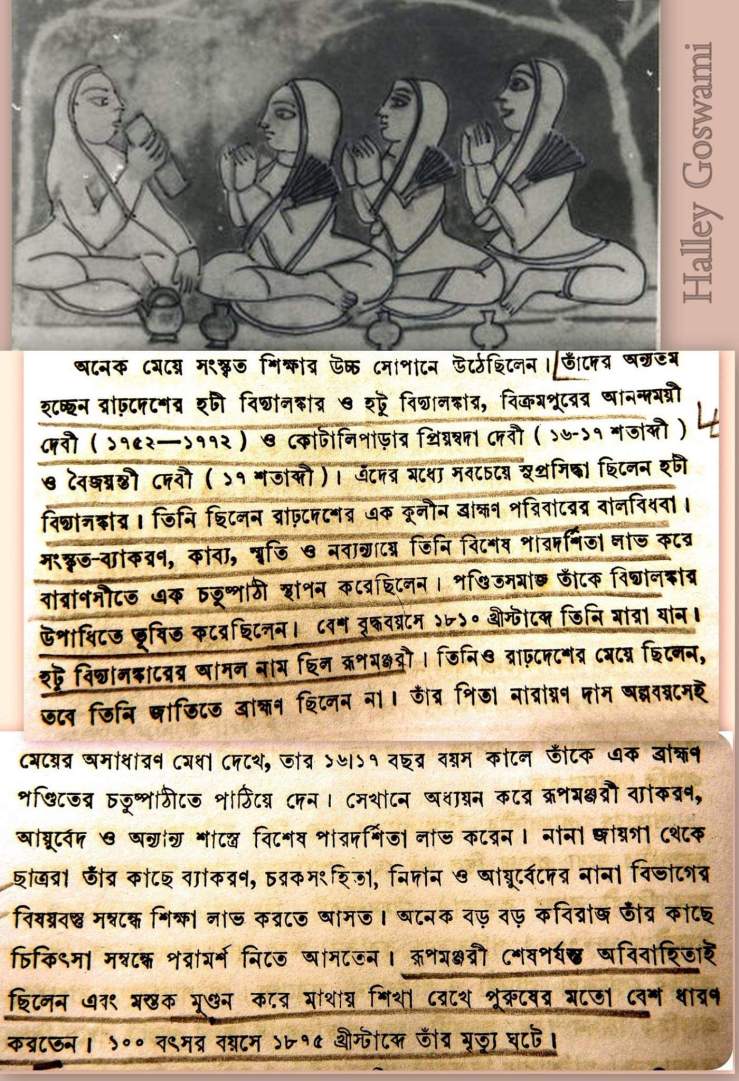
On Hotee Vidyalankar and other learned brAhmaNa ladies

Copying from Halley Gowami because some things deserve a more permanent media than a Facebook post

18815165_1379391695464085_8999940936417102641_o

” Some ladies recieved higher education and managed to rise to great hieghts ! Amongst such rare women , Hotee Vidyalankar , Hotu Vidyalankar , Anandamayee Devi (1752 — 1772) and Priyamvada Devi (16th cent–17th cent) stands out .
Hotee Vidyalankar was the most famous of them all . Born to ‘kulin’ brahmin family she was a widow from childhood . She became an authority on Sanskrit grammer , poetry , Smriti , Navya-nyay and established her own ‘chatuspathi’ ( centers of higher learning ) at Varanasi ! Brahman Pandits bestowed her with the title of Vidyalankar . She died at an advanced age in the year 1810 .

Hotu Vidyalankar’s real name was Rupamanjari . She was not a brahmin , but her father , Narayan Das noticed her exceptional intellgence and sent her at the ‘chatuspaathi’ of a brahmin pandit . There Rupamanjari mastered Ayurved , Grammer and other branches of studies . Her fame spread far and wide and students used to come from far off places to learn or get opinions on Ayurved , charak samhita and grammer . Ayurvedic doctors of the age used to consult her on matters of medicine ! Rupamanjari never married and kept her head shaven with a ‘shikha’ ( Chuda / tuft of hair ) and dressed as a man . She died 100 years of age at 1875 . ”

Someone in the comments mentions that Narayan Sanyal wrote a book রূপমঞ্জরী on haTI vidyAla~Nkara.


Āgāmavāgiśa’s dhyānas from Bṛhat Tantrasāra that more closely match the Kālī mūrtis in Bengal than the one popularly recited

The one that is ‘popularly recited’ in many places runs

करालवदनां घोरं मुक्तकेशीं चतुर्भुजं । कालिका दक्षिणां दिव्यां मुण्डमाला विभूषिता ।।
सद्यछिन्नशीरा खड्ग वामदोर्ध्व कराम्बुजं । अभयंवरदं चैव दक्षिणोर्ध्वद पाणिकं ।।
महामेघप्रभां श्यामां तथा चैव दिगम्बरीं । कंठावासक्त मुण्डाली गलद्रधीर चर्चिताम् ।।
कर्णावतं सतानीत शवयुग्म भयानकं । घोरदंष्ट्राम करालस्याम् पीनोन्नत पयोधराम् ।।
शवानं करसंघाती कृतकंची हसन्मुखी । सृक्कद्वया गलद्रक्त धाराविस्फ़ुरिटाननां ।।
घोररावा महारौद्रिं शमशानालय वसिनिं । बालार्कमण्डलाकारं लोचनं त्रितयान्वितां ।।
दनतुरं दक्षिणं व्यापि मुक्तलन्विक चोचयां । शवरुप महादेव हृदयोपरि संस्थितं ।।
शिवाभिर्घोररावाभिश्चतुर्दिक्षु समन्वितां । महाकालेन च सामं विपरित रातातुरां ।।
सुखप्रसन्न वदनां स्मेरनानना सरोरूहं । एवं संचिन्तयेत् काली धर्मकामार्थसिद्धिदा ।।

karālavadanāṃ ghoraṃ muktakeśīṃ caturbhujaṃ । kālikā dakṣiṇāṃ divyāṃ muṇḍamālā vibhūṣitā ।।
sadyachinnaśīrā khaḍga vāmadordhva karāmbujaṃ । abhayaṃvaradaṃ caiva dakṣiṇordhvada pāṇikaṃ ।।
mahāmeghaprabhāṃ śyāmāṃ tathā caiva digambarīṃ । kaṃṭhāvāsakta muṇḍālī galadradhīra carcitām ।।
karṇāvataṃ satānīta śavayugma bhayānakaṃ । ghoradaṃṣṭrāma karālasyām pīnonnata payodharām ।।
śavānaṃ karasaṃghātī kṛtakaṃcī hasanmukhī । sṛkkadvayā galadrakta dhārāvisफ़uriṭānanāṃ ।।
ghorarāvā mahāraudriṃ śamaśānālaya vasiniṃ । bālārkamaṇḍalākāraṃ locanaṃ tritayānvitāṃ ।।
danaturaṃ dakṣiṇaṃ vyāpi muktalanvika cocayāṃ । śavarupa mahādeva hṛdayopari saṃsthitaṃ ।।
śivābhirghorarāvābhiścaturdikṣu samanvitāṃ । mahākālena ca sāmaṃ viparita rātāturāṃ ।।
sukhaprasanna vadanāṃ smeranānanā sarorūhaṃ । evaṃ saṃcintayet kālī dharmakāmārthasiddhidā ।।

The source of this in the Bṛhat Tantrasāra(hence called BTS in short) is the Kālītantra…and although this is popularly recited and some people say that Āgāmavāgiśa composed this dhyāna,I have hardly seen Kālī mūrtis that conform to the above lakṣaṇas.

In fact,the Kālī mūrtis I’ve seen in houses and temples conform much closer to the dhyānas laid down below(also from BTS)

शवारुढां महाभीमं घोरदंष्ट्रां वरप्रदां। हास्ययुक्तां त्रिनेत्राङ्च कल्पाल-कर्तृक-करां॥
मुक्त-केशिं ललज्-जिह्वां पिबन्तिम् रुधिरम् मुहुः। चतुर्बाहुयुतम् देवीं वराभयकरां स्मरेत्॥

śavāruḍhāṃ mahābhīmaṃ ghoradaṃṣṭrāṃ varapradāṃ। hāsyayuktāṃ trinetrāṅca kalpāla-kartṛka-karāṃ॥
mukta-keśiṃ lalaj-jihvāṃ pibantim rudhiram muhuḥ। caturbāhuyutam devīṃ varābhayakarāṃ smaret॥

This is from the Siddheśvara tantra. This dhyāna can be followed alone by those who have recieved initiation in Kālī’s single-syllabled vidyā.

Then the dhyāna which conforms to the popular depictions I have seen everywhere(also from BTS) with much less ambiguity(as to the hand positions)

देवी वामोर्द्वाधोहस्ते खड्ग-मुण्डञ्च पूजयेत्।
देव्या दक्ष-हस्तोर्ध्वाधः पूजयेद् अभयं वरम्॥

devī vāmordvādhohaste khaḍga-muṇḍañca pūjayet।
devyā dakṣa-hastordhvādhaḥ pūjayed abhayaṃ varam॥

Dakshina_Kali_Shakespeare_Sarani_Arnab_Dutta_2011

(Image original link: )

This is from the Kālīhṛdaya.

If one is saying that Āgāmavāgiśa ‘popularized’ Kālī,it is this dhyāna that matches. Caveat:Not do raise doubts on the siddha,but I am unaware if Kālīhṛdaya is his own work or not.


Brahmā’s praise of Nārāyaṇa to take up Hayagrīva rūpa to kill Madhu and Kaiṭabha from the Mahābhārata(Śāntiparvan)

unnamed

Hayagrīva slaying an asura(Kalighat painting)

brahmovāca।
oṃ namaste brahmahṛdaya namaste mama pūrvaja ।
lokādyabhuvanaśreṣṭha sāṅkhyayoganidhe prabho ॥
vyaktāvyaktakarācintya kṣemaṃ panthānamāsthitaḥ ।
viśvabhuksarvabhūtānāmantarātmannayonija ।
ahaṃ prasādajastubhyaṃ lokadhāma svayaṃbhuvaḥ ॥
tvatto me mānasaṃ janma prathamaṃ dvijapūjitam ।
cākṣuṣaṃ vai dvitīyaṃ me janma cāsītpurātanam ॥
tvatprasādāttu me janma tṛtīyaṃ vācikaṃ mahat ।
tvattaḥ śravaṇajaṃ cāpi caturthaṃ janma me vibho ॥
nāsatyaṃ cāpi me janma tvattaḥ pañcamamucyate ।
aṇḍajaṃ cāpi me janma tvattaḥ ṣaṣṭhaṃ vinirmitaṃ ॥
idaṃ ca saptamaṃ janma padmajanmeti vai prabho ।
sargesarge hyahaṃ putrastava triguṇavarjita ॥
prathamaḥ puṇḍarīkākṣaḥ pradhānaguṇakalpitaḥ ।
tvamīśvaraḥ svabhāvaśca bhūtānāṃ tvaṃ prabhāvana
tvayā vinirmito’haṃ vai vedacakṣurvayotiga ।
te me vedā hṛtāścakṣurandho jātosmi jāgṛhi ।
dadasva cakṣūṃṣi mama priyo’haṃ te priyosi me ॥

In Devanagari

ब्रह्मोवाच।
ॐ नमस्ते ब्रह्महृदय नमस्ते मम पूर्वज ।
लोकाद्यभुवनश्रेष्ठ साङ्ख्ययोगनिधे प्रभो ॥
व्यक्ताव्यक्तकराचिन्त्य क्षेमं पन्थानमास्थितः ।
विश्वभुक्सर्वभूतानामन्तरात्मन्नयोनिज ।
अहं प्रसादजस्तुभ्यं लोकधाम स्वयंभुवः ॥
त्वत्तो मे मानसं जन्म प्रथमं द्विजपूजितम् ।
चाक्षुषं वै द्वितीयं मे जन्म चासीत्पुरातनम् ॥
त्वत्प्रसादात्तु मे जन्म तृतीयं वाचिकं महत् ।
त्वत्तः श्रवणजं चापि चतुर्थं जन्म मे विभो ॥
नासत्यं चापि मे जन्म त्वत्तः पञ्चममुच्यते ।
अण्डजं चापि मे जन्म त्वत्तः षष्ठं विनिर्मितं ॥
इदं च सप्तमं जन्म पद्मजन्मेति वै प्रभो ।
सर्गेसर्गे ह्यहं पुत्रस्तव त्रिगुणवर्जित ॥
प्रथमः पुण्डरीकाक्षः प्रधानगुणकल्पितः ।
त्वमीश्वरः स्वभावश्च भूतानां त्वं प्रभावन
त्वया विनिर्मितोऽहं वै वेदचक्षुर्वयोतिग ।
ते मे वेदा हृताश्चक्षुरन्धो जातोस्मि जागृहि ।
ददस्व चक्षूंषि मम प्रियोऽहं ते प्रियोसि मे ॥

Copypasting Ganguli’s translation(since I’m very short on time): http://www.sacred-texts.com/hin/m12/m12c047.htm

“Brahma said, ‘I bow to thee, O heart of Brahman. I bow to thee that hast been born before me. Thou art the origin of the universe. Thou art the foremost of all abodes. Thou, O puissant one, art the ocean of Yoga with all its branches. Thou art the Creator of both what is Manifest and what is Unmanifest. Thou treadest along the path whose auspiciousness is of inconceivable extent. Thou art the consumer of the universe. Thou art the Antaralock (Inner Soul) of all creatures. Thou art without any origin. Thou art the refuge of the universe. Thou art self-born; for origin thou hest none that is not thyself. As regards myself, I have sprung through thy Grace. From thee have I derived my birth. My first birth from thee, which is regarded sacred by all regenerate persons, was due to a fiat of thy Mind. My second birth in days of yore was from thy eyes. Through thy Grace, my third birth was from thy speech. My fourth birth. O puissant Lord, was from thy ears. My fifth birth, excellent in all respects, was from thy nose. O Lord, My sixth birth was, through thee, from an egg. This is my seventh birth. It has occurred, O Lord, within this Lotus, and it is meant to stimulate the intellect and desires of all the beings. At each Creation I take birth from thee as thy son, O thou that art divested of the three attributes. Indeed, O lotus-eyed one, I take birth as thy eldest son, made up of Sattwa the foremost of three attributes. Thou art endued with that nature which is Supreme. Thou springest from thyself. I have been created by thee. The Vedas are my eyes. Hence, I transcend Time itself. Those Vedas, which constitute my eyes, have been taken away from me. I have, therefore, become blind. Do Thou awake from this Yoga-sleep. Give me back my eyes. I am dear to thee and thou art dear to me.

For shivarAtri:arjuna with shiva kirATa,along with his hymn to him(from the Mahabharata,vana parva)

Screenshot_2019-03-03_19-21-42


From the Vana Parva,text of arjuna’s stotra along with Ganguli’s translation(Am using the Kumbhakonam recension)

kapardinsarvabhūteśa bhaganetranipātana ।
[devadeva mahādeva nīlagrīva jaṭādhara ॥ 3-39-74 (17332)
kāraṇānāṃ ca paramaṃ jāne tvāṃ tryambakaṃ vibhum ।
devānāṃ ca gatiṃ devaṃ tvatprasūtamidaṃ jagat ॥ 3-39-75 (17333)
ajeyastvaṃ tribhirlokaiḥ sadevāsuramānuṣaiḥ ।
śivāya viṣṇurūpāya viṣṇave śivarūpiṇe ॥ 3-39-76 (17334)
dakṣiyajñavināśāya harirūpāya te namaḥ ।
lalāṭākṣāya śarvāya mīḍhuṣe śūlapāṇaye ॥ 3-39-77 (17335)
pinākagoptre sūryāya maṅgalyāya ca vedhase ।
prasādaye tvāṃ bhagavansarvabhūtamaheśvara ॥ 3-39-78 (17336)
gaṇeśaṃ jagataḥ śambhuṃ lokakāraṇakāraṇam ।
pradhānapuruṣātītaṃ paraṃ sūkṣmataraṃ haram ॥ 3-39-79 (17337)
vyatikramaṃ me bhagavankṣantumarhasi śaṃkara ।
bhagavandarśanākāṅkṣī prāptosmīmaṃ mahāgirim ॥ 3-39-80 (17338)
dayitaṃ tava deveśa tāpasālayamuttamam ।
prasādaye tvāṃ bhagavansarvalokanamaskṛtam ॥ 3-39-81 (17339)
kṛto mayā’yamajñānādvimardo yastvayā saha ।
śaraṇaṃ pratipannāya tatkṣamasvādya śaṃkara ॥

कपर्दिन्सर्वभूतेश भगनेत्रनिपातन ।
[देवदेव महादेव नीलग्रीव जटाधर ॥ ३-३९-७४ (१७३३२)
कारणानां च परमं जाने त्वां त्र्यम्बकं विभुम् ।
देवानां च गतिं देवं त्वत्प्रसूतमिदं जगत् ॥ ३-३९-७५ (१७३३३)
अजेयस्त्वं त्रिभिर्लोकैः सदेवासुरमानुषैः ।
शिवाय विष्णुरूपाय विष्णवे शिवरूपिणे ॥ ३-३९-७६ (१७३३४)
दक्षियज्ञविनाशाय हरिरूपाय ते नमः ।
ललाटाक्षाय शर्वाय मीढुषे शूलपाणये ॥ ३-३९-७७ (१७३३५)
पिनाकगोप्त्रे सूर्याय मङ्गल्याय च वेधसे ।
प्रसादये त्वां भगवन्सर्वभूतमहेश्वर ॥ ३-३९-७८ (१७३३६)
गणेशं जगतः शम्भुं लोककारणकारणम् ।
प्रधानपुरुषातीतं परं सूक्ष्मतरं हरम् ॥ ३-३९-७९ (१७३३७)
व्यतिक्रमं मे भगवन्क्षन्तुमर्हसि शंकर ।
भगवन्दर्शनाकाङ्क्षी प्राप्तोस्मीमं महागिरिम् ॥ ३-३९-८० (१७३३८)
दयितं तव देवेश तापसालयमुत्तमम् ।
प्रसादये त्वां भगवन्सर्वलोकनमस्कृतम् ॥ ३-३९-८१ (१७३३९)
कृतो मयाऽयमज्ञानाद्विमर्दो यस्त्वया सह ।
शरणं प्रतिपन्नाय तत्क्षमस्वाद्य शंकर ॥

[O Kapardin, O chief of all gods, O destroyer of the eyes of Bhaga, O god of gods, O Mahadeva, O thou of blue throat, O thou of matted locks, I know thee as the Cause of all causes. O thou of three eyes, O lord of all! Thou art the refuge of all the gods! This universe hath sprung from thee. Thou art incapable of being vanquished by the three worlds of the celestials, the Asuras, and men. Thou art Siva in the form of Vishnu, and Vishnu in the form of Siva. Thou destroyedest of old the great sacrifice of Daksha. O Hari, O Rudra, I bow to thee. Thou hast an eye on thy forehead. O Sarva, O thou that rainest objects of desire, O bearer of the trident, O wielder of the Pinaka, O Surya, O thou of pure body, O Creator of all, I bow to thee. O lord of all created things, I worship thee to obtain thy grace. Thou art the lord of the Ganas, the source of universal blessing, the Cause of the causes of the universe. Thou art beyond the foremost of male beings, thou art the highest, thou art the subtlest, O Hara! O illustrious Sankara, it behoveth thee to pardon my fault. It was even to obtain a sight of thyself that I came to this great mountain, which is dear to thee and which is the excellent abode of ascetics. Thou art worshipped of all worlds. O lord, I worship thee to obtain thy grace. Let not this rashness of mine be regarded as a fault–this combat in which I was engaged with thee from ignorance. O Sankara, I seek thy protection. Pardon me all I have done.]